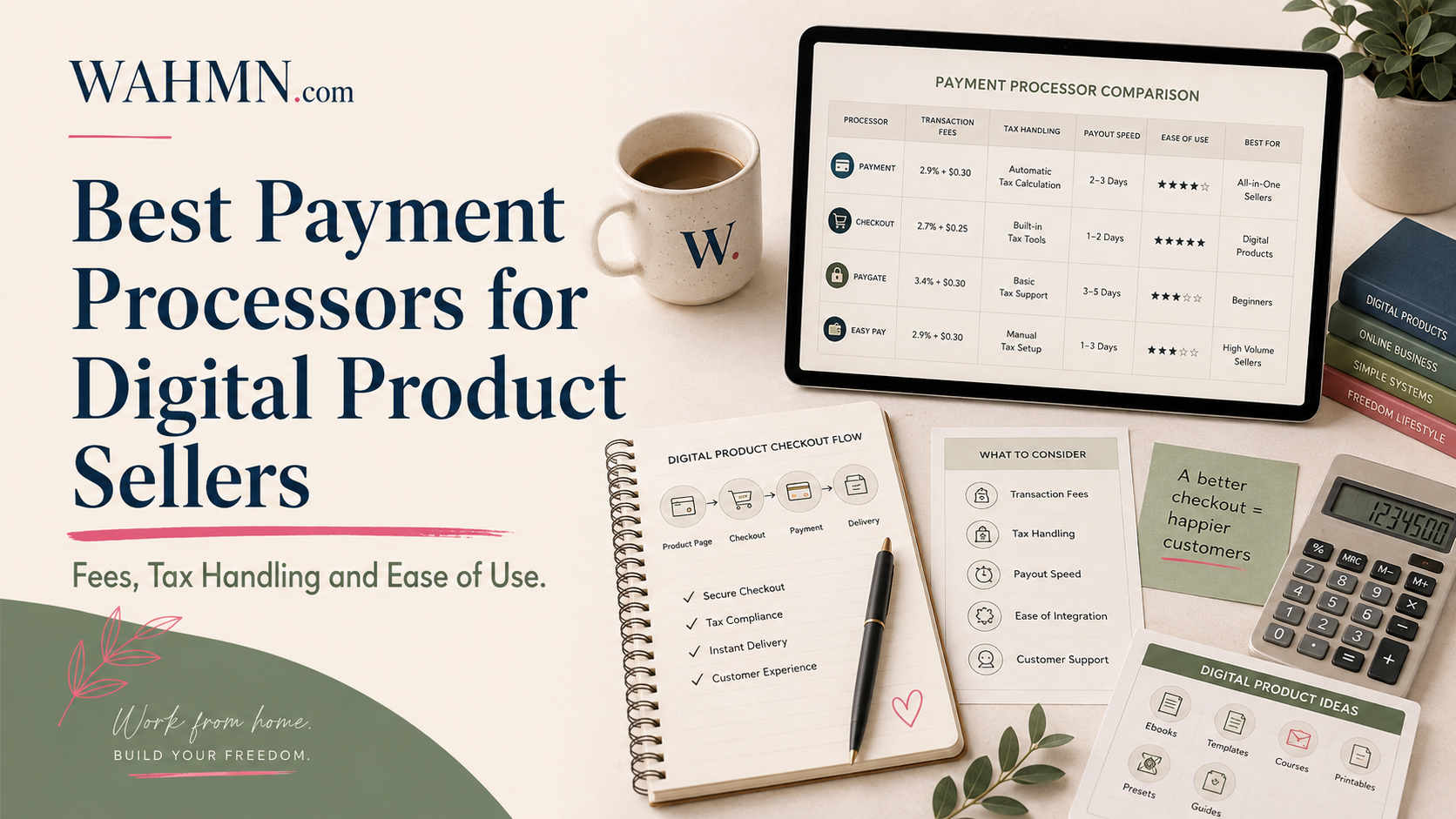
Best Payment Processors for Digital Product Sellers: Fees, Tax Handling and Ease of Use
In this article
- Current research / verification notes
- Introduction: Answer the architecture question first
- Define the terms before comparing products
- What digital-product sellers should compare
- Quick comparison table
- Stripe standard payments
- PayPal
- Square
- Platform-native processors
- Merchant-of-record alternatives
- Processor vs MoR: the decision that matters
- Tax handling: do not confuse calculation with remittance
Selling intangible goods online requires more than just a simple checkout button. Whether you are an educator, a software developer, or a creator, you need a robust system that manages complex global tax laws and transaction fees automatically.
Finding the best payment processor for digital products can feel overwhelming. You must balance user experience with backend security to ensure your business scales smoothly. A reliable payment processor for digital products acts as the backbone of your revenue stream, handling everything from currency conversion to automated receipts.
This guide explores sixteen essential factors to help you choose the right tool for your specific needs. We will break down how top platforms handle compliance, pricing structures, and integration ease. Let’s navigate these options together to find a solution that supports your growth in the United States and beyond.
Key Takeaways
- Digital sellers require specialized tools that go beyond basic checkout functionality.
- Automated tax compliance is a critical feature for global sales.
- Transaction fees significantly impact your bottom line over time.
- Ease of use ensures a seamless experience for your customers at checkout.
- Integration capabilities allow your store to connect with other essential business software.
- Choosing the right platform helps you scale your operations efficiently.
Current research / verification notes
Understanding the fine print is the most important step when selecting a payment processor for digital products. Many providers update their terms of service and fee structures without significant public notice. Because these policies shift frequently, you should treat marketing claims as starting points rather than absolute facts.
When you evaluate a potential partner, always verify the current United States pricing and tax remittance policies directly on their official website. Marketing materials often highlight best-case scenarios that may not apply to your specific business model or monthly sales volume. It is vital to distinguish between standard features and add-on services that carry extra costs.
To ensure you choose the right payment processor for digital products, follow these verification steps before signing any long-term agreements:
- Check the official fee schedule for current transaction percentages and fixed costs.
- Confirm if the provider handles global tax compliance or if you remain responsible for calculation.
- Review the documentation regarding account holds and the specific triggers for risk reviews.
- Test the checkout experience to see if it aligns with your brand’s conversion goals.
Relying on outdated reviews can lead to unexpected financial strain. Always prioritize verified data over general industry assumptions. By taking the time to confirm these details, you protect your business from hidden fees and operational surprises.
Ultimately, the best payment processor for digital products is one that offers transparency alongside its technical capabilities. Stay diligent, keep your records updated, and never hesitate to contact support teams to clarify how their current policies impact your specific digital sales.
Introduction: Answer the architecture question first
Finding the best payment processor for digital products requires looking at more than just transaction fees. You must first decide on the underlying architecture that will power your sales. This choice dictates how you handle global taxes, manage customer data, and scale your operations over time.
Most sellers choose between three primary models: standalone processors, platform-native checkouts, or a merchant of record. Each approach offers a different balance of control and convenience. Understanding these differences early helps you avoid costly migrations later as your business grows.
When evaluating any payment processor for digital products, focus on three core pillars: fees, tax handling, and ease of use. While low fees are attractive, they often come at the cost of manual tax compliance or complex integration requirements. The following table provides a high-level overview of how these models compare in a real-world environment.
| Model | Tax Responsibility | Setup Complexity | Primary Benefit |
|---|---|---|---|
| Standalone Processor | Seller | High | Lower transaction fees |
| Platform-Native | Varies | Low | Seamless integration |
| Merchant of Record | Provider | Very Low | Global compliance |
Define the terms before comparing products
Navigating the world of online sales requires a clear grasp of industry terminology. When you search for the best payment gateway for digital products, you will encounter several overlapping terms that often confuse new entrepreneurs.
A payment processor acts as the engine that moves money from your customer’s bank to your merchant account. In contrast, a payment gateway is the digital bridge that securely transmits transaction data from your website to the processor. Think of the gateway as the secure lock on your digital storefront door.
“The complexity of global tax compliance often outweighs the convenience of a simple payment gateway.”
Many sellers also use a checkout platform, which provides the user interface where customers enter their payment details. However, a Merchant of Record (MoR) is a different entity entirely. An MoR takes legal responsibility for the transaction, including the complex tasks of tax calculation and tax remittance.
It is vital to distinguish between tax calculation and tax remittance. Calculation involves determining the correct sales tax based on the buyer’s location, while remittance is the actual act of paying those collected funds to the government. Many standard gateways handle the former but leave the latter to you.
| Term | Primary Function | Tax Responsibility |
|---|---|---|
| Payment Gateway | Data Transmission | None |
| Payment Processor | Funds Transfer | None |
| Merchant of Record | Legal Liability | Full Remittance |
Choosing the best payment gateway for digital products depends on whether you want to manage your own tax filings or outsource that burden to an MoR. Understanding these definitions ensures you select a tool that aligns with your business goals.
What digital-product sellers should compare
Navigating the world of payment processing for digital downloads involves balancing convenience with cost. Because your products are delivered automatically, you need a system that handles high-volume, low-cost transactions without eating into your margins.
Independent sellers in the United States must look beyond simple fee structures. You need a partner that supports your specific business model, whether you sell one-time files or recurring memberships.
When evaluating your options for payment processing for digital downloads, consider these essential criteria:
- Transaction Fees: Look for transparent pricing that does not hide extra costs for international cards or currency conversion.
- Recurring Billing: Ensure the platform supports automated subscription management if you offer ongoing access to content.
- Payment Methods: Offer flexibility by accepting major credit cards, digital wallets like Apple Pay, and local bank transfers.
- Payout Timing: Check how quickly funds move from the processor to your bank account, as cash flow is vital for small businesses.
- Fraud Controls: Use built-in security tools to protect your store from chargebacks and unauthorized transactions.
- Integrations: Verify that the processor connects easily with your existing website builder or email marketing software.
- Refunds and Records: Prioritize systems that make issuing refunds simple and provide clean, exportable data for your tax filings.
The best payment processing for digital downloads will act as a silent partner in your growth. It should handle the technical heavy lifting while you focus on creating high-quality content for your audience. Always test the checkout experience yourself to ensure it feels professional and secure for your customers.
Quick comparison table
Finding the best payment processor for digital products requires a clear look at your specific business needs. Every platform offers different strengths, ranging from simple setup to complex global tax compliance.
The following table highlights how major providers compare across key categories. Use this data to identify which tool aligns with your current sales volume and technical requirements.
| Provider | Fee Structure | Tax Handling | Subscriptions | Ease of Use |
|---|---|---|---|---|
| Stripe | Standardized | Manual/Add-on | Robust | High |
| PayPal | Variable | Basic | Supported | Very High |
| Square | Competitive | Limited | Integrated | High |
| Platform-Native | Varies | Automated | Built-in | Very High |
| Merchant of Record | Premium | Full Service | Advanced | Moderate |
When evaluating these options, keep in mind that the best payment processor for digital products often depends on your growth stage. Consider these factors before making your final selection:
- Tax Compliance: Do you need automated VAT and sales tax remittance?
- Integration: Does the processor work seamlessly with your current website builder?
- Global Reach: Can the tool handle international currencies and local payment methods?
- Payout Speed: How quickly do you need access to your earned revenue?
Choosing the right partner simplifies your operations and allows you to focus on creating great content. Always review the latest fee schedules to ensure your choice remains the best payment processor for digital products for your specific budget.
Stripe standard payments
If you are looking for the best payment gateway for digital products, Stripe offers a robust suite of tools designed for modern businesses. Many creators choose this platform because it balances ease of use with deep technical flexibility. Whether you are a solo developer or a growing brand, the infrastructure adapts to your specific needs.
Stripe provides two primary ways to handle transactions: hosted checkout and embedded elements. Hosted checkout allows you to redirect users to a secure, Stripe-managed page, which simplifies your compliance requirements. Alternatively, embedded elements let you keep customers on your own website, providing a seamless brand experience that often increases conversion rates.
Beyond the checkout flow, the platform excels in developer flexibility. You can use webhooks to trigger automated actions, such as granting access to a download link immediately after a successful payment. This level of control is why many consider it the best payment gateway for digital products when customization is a priority.
Managing your business operations is also straightforward with their built-in tools. Stripe handles complex subscription billing, automated tax calculations through Stripe Tax, and streamlined refund processes. If a customer requests a refund, you can initiate it directly through the dashboard or via API, keeping your accounting clean and efficient.
| Feature | Stripe Capability | Benefit to Seller |
|---|---|---|
| Checkout Options | Hosted or Embedded | High conversion control |
| Payment Methods | Global support | Accepts cards, wallets, and local methods |
| Developer Tools | Extensive API & Webhooks | Automated workflows |
| Subscription Logic | Native Billing | Scalable recurring revenue |
| Gateway Status | Best payment gateway for digital products | Industry-standard reliability |
PayPal
For many digital creators, the debate regarding Stripe vs PayPal digital products centers on brand recognition and user convenience. Because millions of shoppers already hold active accounts, PayPal offers a level of instant trust that can reduce cart abandonment. Customers often feel more comfortable clicking a familiar button rather than entering credit card details into a new site.
Beyond simple recognition, PayPal provides a robust digital wallet experience. This allows users to pay using stored balances, linked bank accounts, or saved cards without needing to type in sensitive information every time. Streamlined checkout options are a major advantage for sellers who want to minimize friction during the buying process.
When analyzing Stripe vs PayPal digital products, it is important to consider how each platform handles disputes and account risks. PayPal is well-known for its buyer-centric dispute resolution process, which can sometimes feel challenging for sellers. Proactive account management is essential, as the platform may place holds on funds if they detect sudden spikes in sales volume or high refund rates.
Sellers should also keep the following operational factors in mind:
- Payout speed: Transfers to linked bank accounts are generally reliable but may take a few business days.
- Global reach: The platform supports a vast array of international currencies and local payment methods.
- Integration flexibility: You can use standard buttons or more advanced API-driven checkouts.
Finally, while the interface is user-friendly, you must remain diligent regarding your tax obligations. Even when using Stripe vs PayPal digital products, the responsibility for tracking sales and reporting income to the United States government rests entirely with you. Always consult with a tax professional to ensure your business stays compliant with current reporting requirements.
Square
If your business model bridges the gap between brick-and-mortar retail and digital product delivery, Square deserves a closer look. While many associate the brand with physical card readers, it has built a robust ecosystem that supports online commerce. For sellers who manage both physical inventory and virtual assets, this platform offers a unified dashboard to track all revenue streams.
When it comes to payment processing for digital downloads, Square provides a reliable foundation. However, it is important to note that Square is not a dedicated digital delivery platform. You will likely need to integrate it with third-party software to handle automated file delivery and secure access links for your customers.
“The beauty of a unified commerce platform lies in the ability to see your entire business health in one place, whether the sale happened in a shop or on a website.”
Square excels in its transparent pricing model and powerful invoicing tools. These features are particularly helpful for creators who offer custom digital services alongside standard downloads. The reporting suite allows you to segment your sales data, making it easier to understand which products drive your growth.
The following table highlights how Square compares to other solutions when you focus on payment processing for digital downloads:
| Feature | Square Capability | Best For |
|---|---|---|
| Payment Processing | High reliability | Omnichannel sellers |
| Digital Delivery | Requires integration | Customized setups |
| Reporting | Advanced analytics | Data-driven owners |
| Invoicing | Built-in tools | Service-based sales |
Ultimately, Square is a strong contender if you prioritize operational simplicity across different sales channels. By pairing their payment tools with a specialized digital delivery app, you can create a seamless experience for your customers while keeping your financial reporting centralized.
Platform-native processors
Modern ecommerce platforms often bundle payment processing to simplify the setup for new sellers. Services like Teachable, Kajabi, or Substack allow you to accept payments without configuring a separate gateway. This all-in-one convenience is perfect for creators who want to focus on content rather than technical infrastructure.
When you use these built-in tools, the platform often acts as the merchant of record for digital products. This means the service handles the complex web of global sales tax, VAT, and compliance on your behalf. By taking on this legal burden, they provide a significant safety net for international sales.
However, this convenience comes with specific trade-offs that every seller should consider:
- Platform Lock-in: Moving your business to another provider becomes difficult because your payment history and customer data are tied to their system.
- Payout Rules: You must follow the platform’s specific schedule, which may be slower than direct processor payouts.
- Customization: You often lose control over the checkout experience, as the platform dictates the design and flow.
If you prioritize speed and legal simplicity, acting as a merchant of record for digital products through a native processor is a smart move. Portability is the main sacrifice here. If you plan to scale rapidly or need deep integration with custom accounting software, you might eventually outgrow these bundled solutions.
Ultimately, evaluate whether the time saved on tax compliance outweighs the loss of control over your checkout process. For many small-scale creators, the reduced administrative overhead is well worth the trade-off. Always check the platform’s terms to see exactly how they manage your funds and tax liabilities.
Merchant-of-record alternatives
When you sell digital goods, you face complex tax obligations in every region where your customers live. While a standard processor handles the movement of money, a merchant of record for digital products takes on the legal burden of the transaction itself.
These services act as the official seller of your goods to the end customer. By doing so, they automatically calculate, collect, and remit sales tax and VAT on your behalf. This automated compliance can save you countless hours of administrative work.
Many sellers wonder if this is the best payment gateway for digital products compared to traditional options. Unlike a simple gateway, an MoR service assumes the liability for payment risk and tax reporting. This shift in responsibility is a major advantage for businesses that want to avoid the complexities of international tax law.
However, you should not assume that using an MoR removes all your responsibilities. You must still carefully review your contracts, reporting requirements, and product eligibility. It is vital to understand how these services handle refunds and your specific jurisdiction-based obligations.
Popular platforms like Paddle and Lemon Squeezy serve as a merchant of record for digital products by integrating the entire checkout experience. They provide a unified solution that manages the financial and legal side of your sales. Choosing this path allows you to focus on creating content rather than managing global tax compliance.
Processor vs MoR: the decision that matters
The divide between using a payment processor for digital products and hiring a merchant of record (MoR) defines your operational freedom. While many sellers start with direct processors, the transition to an MoR model represents a fundamental shift in how you handle global business.
When evaluating Stripe vs PayPal digital products, you are essentially choosing between two powerful tools that keep you in the driver’s seat. Both platforms offer excellent integration, but they require you to manage your own tax compliance, chargeback disputes, and international regulatory hurdles.
“True business growth happens when you stop managing the plumbing of your payments and start focusing entirely on the value you deliver to your customers.”
Choosing a merchant of record changes this dynamic significantly. An MoR acts as the legal seller of your goods, which means they take on the burden of global tax remittance and compliance. This outsourced model provides peace of mind, though it often comes with higher transaction fees compared to a standard payment processor for digital products.
You must weigh the value of your time against the cost of these services. If you prefer total control over the customer experience and data, staying with a direct processor is usually the better path. However, if you want to scale internationally without the headache of local tax laws, an MoR offers unmatched flexibility for long-term growth.
Ultimately, neither a processor nor an MoR is a one-size-fits-all solution. Your decision should reflect your current sales volume, your appetite for administrative work, and your vision for the future of your digital brand.
Tax handling: do not confuse calculation with remittance
Tax compliance is often the most misunderstood aspect of choosing a payment processor for digital products. Many sellers assume that because a tool calculates the correct sales tax, it also handles the filing and remittance to state authorities.
In reality, most standard processors only provide the math. You remain responsible for the actual tax filing and payment to the government, which creates significant administrative exposure for your business.
Refunds and chargebacks
Managing refunds and chargebacks is a hidden cost that impacts your bottom line. When a customer requests a refund, many processors keep the original transaction fee, meaning you lose money on every reversed sale.
Chargebacks are even more damaging. They often trigger additional fees and can negatively impact your standing with the provider, potentially leading to restricted access to your funds.
Account holds and risk
Digital goods are frequently flagged as high-risk by financial institutions. Because there is no physical shipping to prove delivery, a sudden spike in sales can trigger an automatic account hold.
These holds can freeze your revenue for weeks while the provider investigates your business model. Choosing a payment processor for digital products that understands your specific industry can help mitigate these sudden interruptions.
Subscriptions vs one-time downloads
Recurring billing requires a different level of technical reliability than one-time downloads. If your subscription logic fails, you lose monthly recurring revenue instantly.
Ensure your chosen system handles dunning management and card updates automatically. This reduces churn and keeps your cash flow steady without manual intervention.
Checkout conversion vs fee obsession
Many sellers focus exclusively on the advertised transaction percentage, but this is a mistake. A slightly higher fee is often worth it if the checkout flow is seamless and optimized for mobile users.
If your checkout process is clunky, you will lose more money in abandoned carts than you would ever save on processing fees. Prioritize a payment processor for digital products that offers a frictionless experience to maximize your total revenue.
Real fee math for low-priced products
When you sell low-priced digital goods, every cent lost to transaction fees impacts your bottom line. A flat fee of thirty cents might seem negligible on a fifty-dollar course, but it represents a significant chunk of a two-dollar template. Understanding these margins is the first step toward choosing the best payment processor for digital products.
Which setup fits each seller
Your ideal setup depends heavily on your average order value and your monthly sales volume. If you sell high-volume, low-cost items, you need a processor that minimizes the impact of fixed transaction costs. Consider these factors when evaluating your options:
- Average Order Value: Lower prices require lower fixed fees to maintain profitability.
- Customer Preference: Offering a familiar checkout experience often increases conversion rates.
- Refund Policy: Some processors retain the original transaction fee during a refund, which can hurt your margins.
When Stripe is likely a fit
Stripe is often the go-to choice for creators who want a seamless, white-label checkout experience. When comparing Stripe vs PayPal digital products, Stripe usually wins on customization and developer flexibility. It is highly effective for subscription-based models where you need to manage recurring billing cycles automatically.
Because Stripe integrates deeply into most website builders, it provides a frictionless path for your customers. This reduces cart abandonment, which is vital when your profit margins are already thin due to low product pricing.
When PayPal is useful
PayPal remains a powerhouse because of its massive consumer trust. Many shoppers feel more secure using their existing PayPal balance rather than entering credit card details on a new site. This psychological advantage can lead to higher conversion rates, even if the fee structure is slightly less flexible than other options.
It is particularly useful for international sales where customers may not have access to standard credit card networks. By offering PayPal, you remove a major barrier to entry for global buyers.
When Square makes sense
Square is the best payment processor for digital products if you also operate a physical business or sell in-person services. It offers a unified dashboard that tracks both your digital downloads and your offline sales. This centralized reporting saves you hours of manual bookkeeping every month.
If your digital products are an extension of a brick-and-mortar brand, Square provides the most cohesive ecosystem. It simplifies your tax handling and inventory management by keeping all your revenue streams in one place.
Monthly sales-volume examples
Scaling your digital product business requires a clear view of how different payment setups impact your bottom line. As your revenue grows, the complexity of managing global taxes and compliance often outweighs the benefit of lower transaction fees. Understanding the trade-offs between administrative simplicity and raw cost is essential for long-term success.
When a merchant of record may be worth the higher fee
If you sell globally, a merchant of record for digital products often provides significant value despite higher percentage-based fees. These services handle the burden of calculating, collecting, and remitting sales tax across different jurisdictions. For many creators, this peace of mind is worth the extra cost because it eliminates the risk of non-compliance in foreign markets.
Low-volume sellers might find these fees prohibitive, but high-volume businesses often save money by avoiding expensive accounting audits. When you reach a certain scale, the cost of hiring a tax professional to manage international filings exceeds the premium charged by a merchant of record.
When you do not need to choose separately
Many creators use specialized platforms that integrate payment processing for digital downloads directly into their storefronts. In these cases, the platform acts as the intermediary, and you do not need to select a separate gateway. This setup is ideal for beginners who want to focus on content creation rather than technical financial infrastructure.
Migration and portability
Moving your business to a new provider can be a complex task. If you use a merchant of record, your customer data and subscription records are often locked within their proprietary system. Always verify if your provider allows for easy data export before committing to a long-term contract. Portability ensures that you retain ownership of your customer relationships if you decide to switch providers later.
WAHMN decision tree
The following table helps United States sellers determine the best path based on their specific business needs and volume. Use this guide to align your payment processing for digital downloads strategy with your current growth stage.
| Business Model | Monthly Volume | Recommended Setup | Primary Benefit |
|---|---|---|---|
| Simple Downloads | Under $1,000 | Standard Processor | Lowest Fees |
| Global Subscriptions | $1,000 – $10,000 | Merchant of Record | Tax Compliance |
| Enterprise/High Volume | Over $10,000 | Custom Integration | Cost Efficiency |
| Platform-Native | Any | All-in-One Platform | Ease of Use |
Choosing a merchant of record for digital products is a strategic decision that should evolve alongside your business. Start with the simplest solution that meets your current needs, and prepare to migrate as your volume increases.
International sale example
Selling digital goods to customers in different countries introduces complex layers of tax law and currency exchange. A customer in France buying your software triggers VAT requirements that differ from a sale in California. Using a merchant of record for digital products simplifies this by shifting the legal burden of tax remittance and compliance to the provider. You pay a higher fee for this service, but you gain peace of mind regarding international regulations.
Common Questions
Which setup is best for a new creator? Most beginners start with Stripe or PayPal to keep costs low while testing their market. You can switch to a merchant of record for digital products once your sales volume justifies the added expense of automated tax handling.
Can I change my payment provider later? Yes, most platforms allow you to migrate your customer data. Keep in mind that moving subscription billing requires careful planning to avoid service interruptions for your users.
Do I need to handle refunds manually? Payment processors like Square or Stripe provide dashboards to manage these requests. A merchant of record for digital products often handles these disputes on your behalf, which saves time during high-volume periods.
How do I manage payouts? Most providers offer direct deposits to your bank account on a set schedule. Check your specific platform settings to ensure your currency preferences match your business needs.
FAQ
What is the best payment gateway for digital products if I am just starting out?
When comparing Stripe vs PayPal digital products, which is better for customer conversion?
How does payment processing for digital downloads differ from physical products?
Do I really need a merchant of record for digital products?
Are there specific fees I should look for when choosing a payment processor for digital products?
Can I use Square for selling digital downloads and memberships?
Is it difficult to switch my payment gateway later on?
Keep reading on WAHMN
More articles in this category, browse the full article library, or explore our business tools and learning paths.
Once payments work, pricing and launching decide the rest, which is what Business Launcher covers, with Email Marketing Business keeping the buyers you win.