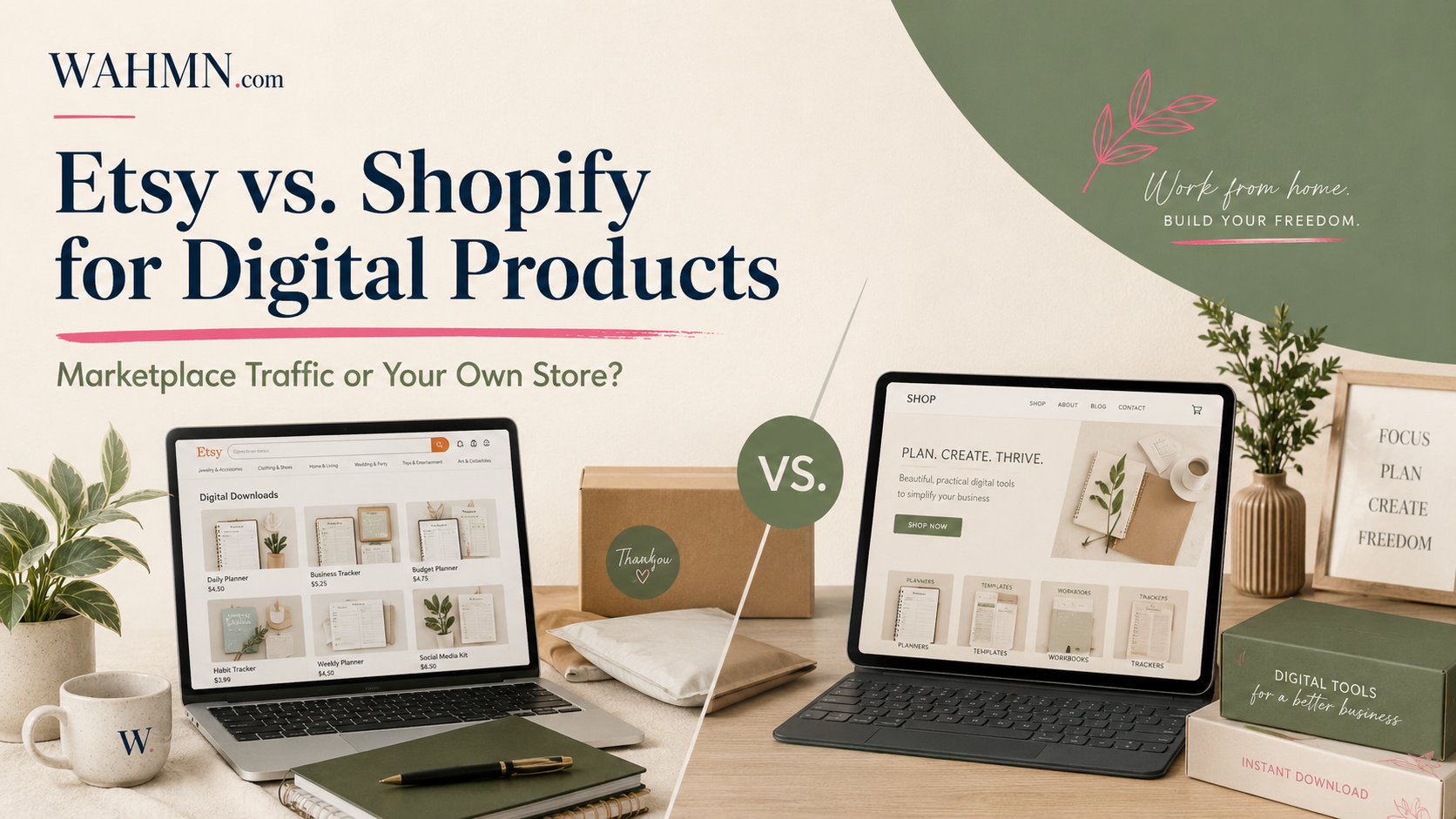
Etsy vs. Shopify for Digital Products: Marketplace Traffic or Your Own Store?
In this article
- Table of Contents
- Etsy vs. Shopify at a Glance
- The Biggest Difference Is Not the Fee
- Which Platform Is Easier to Set Up?
- Etsy Fees for Digital Products
- Shopify Costs for Digital Products
- Etsy vs. Shopify Fee Comparison
- Marketplace Traffic vs. Bringing Your Own Traffic
- Branding and Store Control
- Customer Relationships and Email Marketing
- Etsy SEO vs. Shopify SEO
- Shopify vs Etsy Digital Products: How Search Works
When you are choosing between Shopify vs Etsy for digital products, you are not simply comparing two websites. You are choosing between two very different ways of building a business.
Etsy gives you a place inside an established marketplace where shoppers already search for printables, templates, artwork, invitations, planners and other digital products. Shopify gives you your own ecommerce store, but you are responsible for bringing people to it.
At WAHMN, our practical answer is:
- Start with Etsy when you have no audience, want to test a search-friendly digital product and are comfortable competing inside a marketplace.
- Start with Shopify when you already have traffic, want to build a distinct brand, need more control over your store or plan to sell a larger product line.
- Use both when Etsy is profitable as a customer-acquisition channel and Shopify serves as the long-term home of your business.
The most important difference is not the monthly fee. It is who is responsible for finding the customer and who controls the relationship after the sale.
WAHMN’s quick verdict: Etsy is usually easier for testing demand. Shopify is usually stronger for building an independent digital-product business.
Table of Contents
- Etsy vs. Shopify at a Glance
- The Biggest Difference Is Not the Fee
- Which Platform Is Easier to Set Up?
- Etsy Fees for Digital Products
- Shopify Costs for Digital Products
- Etsy vs. Shopify Fee Comparison
- Marketplace Traffic vs. Bringing Your Own Traffic
- Branding and Store Control
- Customer Relationships and Email Marketing
- Etsy SEO vs. Shopify SEO
- Digital File Delivery
- Taxes and Recordkeeping
- Platform Rules and Business Risk
- Should You Sell on Both Etsy and Shopify?
- Which Platform Fits Your Situation?
- How to Choose in Seven Steps
- Common Mistakes to Avoid
- Final Verdict
- Frequently Asked Questions
Etsy vs. Shopify at a Glance
Pricing and features were checked on August 22, 2026. Software companies can change their plans, fees and policies, so verify the current terms before opening your store.
| Comparison point | Etsy | Shopify |
|---|---|---|
| Business model | Online marketplace | Independent ecommerce store |
| Built-in shopper activity | Yes, but traffic is not guaranteed | No Etsy-style marketplace audience |
| Basic monthly platform fee | No standard monthly fee | Basic plan: $25 monthly or $19 per month when billed annually |
| Listing fee | $0.20 per listing and renewal | No per-product listing fee |
| Platform transaction fee | 6.5% | No additional third-party transaction fee when eligible orders use Shopify Payments |
| U.S. payment processing | 3% plus $0.25 per order | Online card rates start at 2.9% plus $0.30 on Basic |
| Digital delivery | Built into digital listings | Requires a digital-delivery app; Shopify offers a free app |
| Store design control | Limited | High |
| Custom domain | Not for the standard Etsy shop | Yes |
| Customer list control | Restricted | Greater access, subject to consent and privacy laws |
| Email marketing | Etsy buyer emails cannot automatically become marketing subscribers | Opt-in forms, checkout consent and customer exports are available |
| Search strategy | Etsy search | Google, Bing, Pinterest, social media, email and other channels |
| Best for | Testing marketplace-friendly products | Building an owned store and brand |
| Main weakness | Fees, competition and limited customer control | You must generate traffic |
| Long-term scalability | Possible, but within Etsy’s system | Stronger control over products, content, marketing and customer journey |
Etsy currently charges a $0.20 listing fee, a 6.5% transaction fee and, for U.S. sellers, a 3% plus $0.25 Etsy Payments processing fee. Shopify’s U.S. pricing page currently shows Basic at $25 per month when paid monthly or $19 per month when billed annually, with online card rates starting at 2.9% plus $0.30. Promotional and location-specific pricing may differ. If Etsy wins on the numbers, setting up an Etsy shop takes you through it step by step.
The Biggest Difference Is Not the Fee
The central Etsy-versus-Shopify decision is this:
Etsy helps you participate in an existing shopping marketplace. Shopify gives you the infrastructure to build your own store.
An Etsy shopper may search for:
- Printable weekly meal planner
- Editable wedding invitation
- Homeschool schedule
- Small-business bookkeeping spreadsheet
- Canva social media template
- Digital sewing pattern
- Resume template
- Nursery wall art
Your listing can appear while that person is already looking for a product.
That does not mean Etsy automatically sends every shop a steady stream of buyers. Your product still has to match a real search, compete with other listings and earn clicks and sales. Etsy says its search system considers listing quality and customer-service factors, among other signals. Etsy also recommends using relevant attributes and all available tags.
A new Shopify store is different. You may have a beautiful website, excellent products and a smooth checkout, but no one will visit simply because the store exists.
You generally need to bring traffic through channels such as:
- Google search
- An email newsletter
- Instagram or Facebook
- YouTube
- Partnerships
- Affiliate referrals
- Paid advertising
- Existing customers
- Your blog or main business website
Shopify includes built-in SEO features and tools for creating customer segments, collecting leads and running marketing automations. Those tools help you convert and retain visitors, but they do not replace a traffic plan.
Think of It This Way
Etsy is like renting a counter in a busy marketplace.
People are already walking through the marketplace, but:
- You compete with nearby sellers.
- The marketplace controls the layout.
- The marketplace sets many of the rules.
- The marketplace collects several fees.
- Buyers may remember Etsy more than they remember your shop.
Shopify is like opening your own store.
You control more of the experience, but:
- You have to tell people where the store is.
- You pay a predictable platform cost.
- You need a marketing system.
- You are responsible for more business operations.
- You have more opportunities to build a recognizable brand.
Neither model is automatically better. The right choice depends on your product, audience, margin and growth plan.
Which Platform Is Easier to Set Up?
Etsy Is Faster for a Simple First Listing
Etsy usually has the shorter path from idea to published product.
A basic Etsy setup looks like this:
- Create your seller account.
- Choose a shop name.
- Complete identity and payment verification.
- Add your shop logo and banner.
- Create a digital listing.
- Upload the product files.
- Add listing images.
- Write the title and description.
- Choose the price, category, attributes and tags.
- Publish the listing.
Etsy may charge a one-time shop setup fee. The amount, when applicable, is shown during onboarding and can vary, so I have not included it in the ongoing fee examples below.
The standard Etsy shop structure is already built for you. You do not have to choose a website theme, design navigation, configure hosting or build a complete storefront before listing your first product.
That makes Etsy especially useful when your immediate goal is to answer a basic question:
Will anyone pay for this product?
Shopify Takes Longer but Gives You More Control
A basic Shopify setup usually includes:
- Create your Shopify account.
- Choose a plan.
- Select and customize a theme.
- Connect or purchase a domain.
- Add your store policies.
- Set up Shopify Payments or another processor.
- Configure tax settings.
- Install a digital-delivery app.
- Add your products.
- Build product collections and navigation.
- Customize checkout and customer emails.
- Connect analytics and marketing tools.
- Test the complete purchase and download process.
- Create a traffic plan.
- Launch the store.
Shopify does not charge an additional fee simply because you sell digital products, but you need an app to deliver downloads. Shopify currently offers its own free Digital Products app.
For a new seller, Shopify involves more decisions. The advantage is that those decisions help you create a store that reflects your own business instead of fitting inside Etsy’s marketplace layout.
Ease-of-Setup Winner
Etsy wins for getting a basic product listed quickly.
Shopify wins when “easy” means managing a larger, branded store from one central system.
Etsy Fees for Digital Products
Etsy’s low barrier to entry can make it feel inexpensive, but its cost increases with every sale.
For a typical U.S. digital-product order, the core Etsy fees are:
1. Listing Fee
Etsy charges $0.20 to publish a listing. A listing expires after four months unless renewed.
When you sell another unit from a multi-quantity listing, Etsy can automatically renew the listing and charge another $0.20.
2. Transaction Fee
Etsy charges 6.5% of the order amount. For a digital item with no shipping charge, this is generally calculated from the listed product price.
3. Etsy Payments Processing Fee
For a seller with a U.S. bank account, the current Etsy Payments processing fee is 3% plus $0.25 per order. Processing rates vary by country.
4. Offsite Ads Fee
An additional Offsite Ads fee can apply when Etsy advertises your listing outside Etsy and an attributed sale occurs.
The current fee structure is:
- 15% for shops below $10,000 in Etsy sales during the applicable prior 365-day period
- 12% after a shop reaches at least $10,000 in applicable sales
- Shops under the threshold can generally opt out.
- Once a shop reaches the threshold, participation becomes mandatory under Etsy’s current policy, even if future annual sales later fall below the threshold.
Etsy caps the Offsite Ads fee at $100 for one attributed order.
5. Optional Costs
Depending on how you run your shop, you may also pay for:
- Etsy Ads
- Etsy Plus
- Currency conversion
- Regulatory operating fees in certain countries
- Graphic-design software
- Mockup images
- Keyword-research tools
- Contractors or assistants
- Refunds and customer-service costs
Etsy Plus is currently $10 per month, but it is optional and is not required to run a standard Etsy shop.
Example: What Etsy Takes From a $15 Digital Product
For one $15 sale to a U.S. buyer, assuming one product per order and no Offsite Ads:
| Fee | Calculation | Cost |
| Listing renewal | Flat fee | $0.20 |
| Transaction fee | 6.5% of $15 | $0.98 |
| Payment processing | 3% of $15 plus $0.25 | $0.70 |
| Estimated Etsy fees | $1.88 | |
| Estimated amount remaining | Before other expenses and taxes | $13.12 |
That is an effective platform-and-processing cost of about 12.5% on this particular $15 order.
The percentage is higher on low-priced products because the fixed $0.20 listing charge and $0.25 processing charge take a larger share of a small sale.
What Happens if Offsite Ads Apply?
| $15 sale scenario | Estimated fees | Estimated amount remaining |
| No Offsite Ads fee | $1.88 | $13.12 |
| 12% Offsite Ads fee | $3.68 | $11.32 |
| 15% Offsite Ads fee | $4.13 | $10.87 |
Offsite Ads can still be profitable when they produce a customer you would not have reached otherwise. The issue is not that the fee exists. The issue is whether your product price and margin can absorb it.
A $4 printable has much less room for advertising fees than a $39 template bundle.
Shopify Costs for Digital Products
Shopify uses a different cost structure. You pay a recurring platform fee and payment-processing fees, but you do not pay Etsy-style listing and 6.5% marketplace transaction fees.
As of August 22, 2026, Shopify’s U.S. pricing page shows:
- Basic: $25 per month when paid monthly
- Basic billed annually: $19 per month
- Online card rate starting at: 2.9% plus $0.30
- Third-party provider fee on Basic: 2% when a third-party processor is used in situations where the fee applies
Shopify does not charge its additional third-party transaction fee for eligible orders processed through Shopify Payments, Shop Pay, Shop Pay Installments, PayPal Express Checkout or qualifying manual payment methods.
Other Possible Shopify Costs
Your total Shopify cost may also include:
- A custom domain
- A paid theme
- Premium digital-delivery features
- Email marketing costs above included limits
- Upsell or bundle apps
- Affiliate-management software
- Review software
- Advanced analytics
- Tax software or automated filing
- Paid advertising
- Contractor or developer help
You do not need every app on day one.
A careful solo seller can begin with:
- The Basic plan
- A free Shopify theme
- Shopify Payments
- Shopify’s free Digital Products app
- Built-in discount and email tools
- A custom domain
- One outside email platform only when it serves a clear purpose
The danger is “app creep.” A seller can easily turn a $19 or $25 store into a $100-per-month software stack by installing tools she does not yet need.
Etsy vs. Shopify Fee Comparison
The following comparison uses one hypothetical $15 digital bundle.
Assumptions
For Etsy, the calculation includes:
- $0.20 listing renewal per sale
- 6.5% transaction fee
- 3% plus $0.25 U.S. payment-processing fee
- No Offsite Ads
- No Etsy Ads
- One item per order
For Shopify, the calculation includes:
- Basic plan billed annually at $19 per month
- 2.9% plus $0.30 online card processing
- Shopify’s free Digital Products app
- No paid theme
- No paid app
- No domain cost
- No advertising cost
| Monthly sales | Revenue | Estimated Etsy fees | Estimated Shopify cost | Lower direct platform cost |
| 5 | $75 | $9.38 | $22.68 | Etsy |
| 25 | $375 | $46.88 | $37.38 | Shopify |
| 100 | $1,500 | $187.50 | $92.50 | Shopify |
| 500 | $7,500 | $937.50 | $386.50 | Shopify |
Under these assumptions, Shopify’s direct platform and processing costs become lower at approximately 17 monthly sales when the Basic plan is billed annually.
If you pay Shopify’s current $25 month-to-month rate instead, the mathematical crossover is approximately 22 monthly sales.
That does not automatically mean you should move to Shopify at sale number 17.
The fee comparison leaves out the largest unknown expense:
What will it cost you to bring those Shopify customers to your store?
If Etsy generates 25 sales through marketplace searches and your Shopify store generates none, Etsy is more valuable despite the higher fee.
If you already have an email list, Pinterest traffic or a blog that can produce 25 Shopify sales, Shopify may give you a better margin and a stronger long-term business.
The Better Question
Instead of asking only, “Which fee is lower?” ask:
What is my total cost to acquire and serve one profitable customer?
That cost can include:
- Platform fees
- Payment processing
- Advertising
- Content creation
- Pinterest management
- Email software
- Affiliate commissions
- Refunds
- Customer support
- Design tools
- Your own time
A lower transaction fee does not help if your store receives no qualified traffic.
Marketplace Traffic vs. Bringing Your Own Traffic
What Etsy Traffic Can Do for You
Etsy gives your listings the chance to appear in:
- Etsy search results
- Category pages
- Related product recommendations
- Favorites and saved collections
- Etsy marketing emails
- Etsy Ads
- Offsite Ads
- Search-engine results for Etsy pages
This can shorten the path between creating a product and reaching a shopper.
However, Etsy traffic is not guaranteed. A seller still needs to:
- Choose a product people search for
- Use clear, accurate listing images
- Research buyer language
- Select relevant categories and attributes
- Write a useful title
- Use tags carefully
- Set a competitive price
- Earn positive reviews
- Respond to messages
- Avoid policy violations
- Improve listings that receive views but do not convert
Etsy says listing quality, shop quality and customer-service quality can affect search visibility. Its current seller guidance also recommends using relevant attributes and all 13 available tags.
What Shopify Traffic Requires
A Shopify store needs a deliberate customer-acquisition system.
That system might look like this:
- Publish helpful articles for Google.
- Create Pinterest pins for each article and product.
- Offer a useful free resource.
- Collect email subscribers with clear consent.
- Send helpful emails consistently.
- Link relevant products inside articles and emails.
- Create product demonstrations.
- Build affiliate or partner relationships.
- Retarget visitors only when the cost makes sense.
- Improve product pages based on conversion data.
Shopify gives you built-in SEO foundations, editable page titles and meta descriptions, automatically generated sitemaps and other search-friendly features. You still have to create content that deserves to rank and earn clicks.
Traffic Winner
Etsy wins for access to marketplace discovery.
Shopify wins for building a traffic system that belongs to your business.
Branding and Store Control
A buyer on Etsy sees your:
- Shop name
- Shop icon
- Banner
- About section
- Listing images
- Product descriptions
- Reviews
- Shop policies
That gives you some room to create a recognizable shop.
However, the larger experience still belongs to Etsy. The navigation, search results, checkout and surrounding recommendations follow Etsy’s structure.
A shopper viewing your listing may also see competing products.
With Shopify, you control much more of the experience:
- Domain name
- Store theme
- Homepage
- Product collections
- Navigation
- Brand colors
- Typography
- Product-page structure
- Educational content
- Blog
- Lead magnets
- Cross-sells
- Bundles
- Discounts
- Checkout options
- Customer accounts
- Post-purchase communication
Shopify’s Basic plan includes a full online store, themes, unlimited products, hosting, a custom-domain option, marketing tools and customer-segmentation features.
Branding Winner
Shopify wins for building a distinct, independent brand.
Etsy can still work well when your products are visually strong and searchable, but the marketplace itself remains the dominant brand environment.
Customer Relationships and Email Marketing
This is one of the most important differences between Etsy and Shopify.
Etsy Customer Information Has Strict Limits
An Etsy transaction may give you access to a buyer’s email or other personal information so you can complete the order.
That does not mean the buyer has subscribed to your marketing list.
Etsy’s Seller Policy states that buyer information may be used for Etsy-related communications or Etsy-facilitated transactions. Without proper consent, sellers may not add buyers to an email or physical mailing list or use their identities for unsolicited marketing.
Do not export Etsy customer emails and upload them into Kit, Mailchimp, MailerLite or another email platform unless those buyers have knowingly provided the required marketing consent.
Shopify Gives You More Direct Customer Infrastructure
Shopify allows you to:
- Display an email-marketing consent option at checkout
- Use sign-up forms
- Create customer profiles
- Build segments
- Export customer information
- Send campaigns and automations
- Connect to outside email platforms
The buyer still has to provide valid marketing consent where required. Owning a Shopify store does not give you permission to send unsolicited email.
Shopify’s documentation explains how merchants can display email-marketing opt-in controls and export customer data.
Customer Relationship Winner
Shopify wins.
The advantage is not simply that Shopify gives you an email address. The advantage is that it gives you the infrastructure to build a consent-based relationship through your own store.
That relationship can produce:
- Repeat purchases
- Product feedback
- Launch audiences
- Cross-sells
- Higher-value bundles
- Referrals
- Better customer research
- More predictable revenue
Etsy SEO vs. Shopify SEO
Etsy SEO and Shopify SEO are related, but they are not the same job.
Shopify vs Etsy Digital Products: How Search Works
Etsy SEO
Etsy SEO focuses on matching your listing to searches made inside Etsy.
You need to think about:
- The words Etsy shoppers use
- Product category
- Attributes
- Tags
- Listing title
- Description
- Image quality
- Price
- Reviews
- Customer service
- Conversion history
- Shop quality
For example, a vague title such as “Beautiful Life Planner” may not match the way a shopper searches.
A clearer title might be:
Printable Weekly Life Planner, Undated PDF Schedule and Goal-Setting Pages
The goal is not to stuff every possible keyword into the title. The goal is to describe the product clearly using language a buyer would naturally use.
Shopify SEO
Shopify SEO focuses more heavily on external search engines.
You need to think about:
- Product-page titles
- Meta descriptions
- Page content
- Product descriptions
- Image alt text
- Internal links
- Collection pages
- Blog articles
- Site structure
- Search intent
- Backlinks
- Website authority
- Page experience
Shopify includes built-in SEO features, but it cannot create demand or authority for you.
SEO Winner
There is no universal winner.
Etsy is easier when you want to compete for searches inside an existing product marketplace.
Shopify is stronger when you want to build a broader search presence around your own website and content.
Digital File Delivery
Etsy Digital Delivery
Etsy supports:
- Premade instant downloads
- Made-to-order digital products
For digital listings, Etsy currently allows up to five files with a maximum size of 20 MB each. Customers receive an email when the files are ready and can access their purchases through Etsy.
This works well for products such as:
- PDFs
- Small ZIP folders
- Printable pages
- Templates
- Spreadsheets
- Basic graphic bundles
- Digital patterns
It can become limiting when you sell:
- Large video files
- Extensive asset libraries
- Large photography collections
- Large audio packages
- Courses
- Software
- Products with many separate files
You may need to place a PDF inside the Etsy download that contains instructions and an approved access link to the actual product. Review Etsy’s current policies and the terms of any outside storage or template platform before using this method.
Shopify Digital Delivery
Shopify’s free Digital Products app currently supports:
- Files up to 5 GB
- Multiple files per product variant
- ZIP files
- Automatic or manual delivery
- Configurable download limits
- Unlimited download bandwidth
- Download links at checkout
- Customized delivery emails
- Product links to supported providers
Supported link providers currently include services such as Canva, Google Drive, Dropbox, Teachable, Thinkific, Kajabi, Notion, Vimeo and YouTube.
Digital Delivery Winner
Etsy is sufficient for most basic printables and small downloads.
Shopify wins for larger files, broader product formats and more delivery control.
Taxes and Recordkeeping
This section is general business information, not personal tax advice.
Etsy Tax Handling
Etsy operates as a marketplace facilitator in applicable jurisdictions.
For qualifying U.S. orders, including eligible digital orders, Etsy automatically calculates, collects and remits U.S. sales tax on the seller’s behalf. Sellers cannot opt out of this required collection.
Etsy also handles certain digital VAT collection for buyers in applicable countries.
This can remove a substantial administrative burden, although sellers still need accurate bookkeeping and may have reporting obligations.
Shopify Tax Handling
Shopify provides tools to calculate and track taxes, but Shopify states that tax is generally the merchant’s responsibility. Shopify does not automatically file or remit all taxes for every Shopify-store order unless you use an applicable automated filing service or sell through a channel with separate marketplace-facilitator treatment.
This means a Shopify seller may need to:
- Determine where she has tax obligations
- Register where required
- Configure tax collection
- Track taxable sales
- File returns
- Remit collected taxes
- Handle digital-product rules in different jurisdictions
Shopify can help with calculations, liability insights and automated filing options, but those tools do not replace professional guidance for your specific situation.
Tax-Handling Winner
Etsy is simpler for many marketplace tax transactions.
Shopify gives you more control, but it usually places more compliance responsibility on you.
Platform Rules and Business Risk
Neither Etsy nor Shopify is risk-free.
Etsy-Specific Risks
Etsy sellers depend on:
- Etsy’s search system
- Marketplace policies
- Fee changes
- Listing eligibility
- Account standing
- Review history
- Customer-service standards
- Intellectual-property complaints
- Marketplace competition
Etsy requires digital products to be made or designed by the seller. Its current guidance also includes seller-prompted AI creations in its “designed by a seller” category, but sellers remain responsible for originality, accuracy, licensing and compliance.
Do not assume that purchasing a template, graphic, font or stock asset automatically gives you the right to resell it as a digital product. Read the commercial license.
Shopify-Specific Risks
A Shopify seller depends on:
- Shopify’s platform
- Her payment processor
- Installed apps
- Domain access
- Email deliverability
- Traffic sources
- Advertising accounts
- Tax configuration
- Data security
- Her own ability to attract customers
Shopify gives you more operational control, but that control comes with more responsibility.
Reduce Your Risk on Either Platform
Keep independent copies of:
- Product files
- Listing images
- Product descriptions
- Customer-service templates
- Sales reports
- Expense records
- License documents
- Brand files
- Store policies
- Product update history
On Shopify, regularly export product and customer records when appropriate. Shopify supports CSV exports for products, customers and orders.
Should You Sell on Both Etsy and Shopify?
For many digital-product businesses, the strongest long-term answer is not Etsy or Shopify.
It is Etsy and Shopify, with each platform assigned a clear job.
A Practical Dual-Platform Strategy
Etsy’s job: Help qualified marketplace shoppers discover selected products.
Shopify’s job: Serve as your primary branded store, content hub and customer-development system.
You might sell:
- Individual printables on Etsy
- Larger bundles on Shopify
- Entry-level templates on Etsy
- Complete systems on Shopify
- Search-friendly products on Etsy
- Specialized or premium products on Shopify
- A limited Etsy catalog
- Your full product library on Shopify
Do not create artificial confusion by giving the same product several unrelated prices. Differences should be tied to a real difference in:
- File package
- License
- Support
- Bonus materials
- Delivery method
- Product format
- Customer experience
A Sensible Growth Path
Stage 1: Validate
Start with a small Etsy catalog when your product fits marketplace demand.
Your goal is to learn:
- Which product gets impressions
- Which listing gets clicks
- Which product converts
- Which price works
- Which questions buyers ask
- Which images communicate value
Stage 2: Improve
Use actual customer questions to improve:
- Product instructions
- Preview images
- Listing descriptions
- File organization
- Frequently asked questions
- Product bundles
- Naming and positioning
Stage 3: Build an Independent Audience
Develop traffic sources outside Etsy through:
- Search-optimized articles
- YouTube
- Social media
- Partnerships
- A consent-based email list
- Free resources
Do not automatically add Etsy buyers to your marketing list. Ask for valid consent and follow Etsy’s current seller policies.
Stage 4: Launch Shopify
Consider launching Shopify when:
- You have consistent outside traffic.
- You have approximately 15 to 25 or more monthly sales.
- You want to sell more than basic downloads.
- You need stronger bundling or upsell options.
- You have several related products.
- Buyers recognize your business name.
- You want a blog and educational content.
- You want direct, consent-based customer relationships.
- You can comfortably cover the fixed monthly cost.
- Your Etsy fees are becoming meaningful.
The monthly-sales number is not a hard rule. It is simply a checkpoint based on the current direct-fee comparison for a $15 product.
Stage 5: Keep Only Profitable Channels
Track Etsy and Shopify separately.
For each platform, calculate:
Revenue − refunds − platform fees − processing fees − ads − software − affiliate commissions − support costs = contribution before general overhead and tax
Keep both platforms only when both contribute something useful.
Which Platform Fits Your Situation?
Choose Etsy When:
- You have no existing audience.
- Your product matches a common Etsy search.
- You sell printables, invitations, templates, artwork or patterns.
- You want to test an idea before building a full store.
- You can create strong listing images.
- You are comfortable working within marketplace rules.
- You want simpler marketplace tax handling.
- You prefer variable fees to a monthly platform cost.
Choose Shopify When:
- You already have a blog, email list or social following.
- You receive steady Pinterest or Google traffic.
- You want a custom domain.
- You need stronger branding.
- You want to build a larger product library.
- You plan to sell bundles, subscriptions, courses or services.
- You need larger file capacity.
- You want more control over customer communication.
- You are prepared to manage more of the tax and compliance process.
- You can support the monthly cost before sales become consistent.
Choose Both When:
- Etsy produces profitable marketplace sales.
- You also have an independent traffic strategy.
- You can manage two catalogs without mistakes.
- You understand each platform’s role.
- Your products and customer experience are clearly organized.
- The additional work produces enough revenue to justify itself.
Choose Neither When:
Etsy and Shopify are not the only choices.
A simpler platform may be better when:
- You have only one small digital product.
- You do not need a complete ecommerce store.
- You want a platform that handles more tax responsibilities.
- You sell primarily through direct links.
- Your product is a course rather than a download.
- You need an advanced learning-management system.
- You need a community platform.
- You want a very simple checkout with little site maintenance.
Read our comparison of Gumroad vs. Payhip and our guide to the best platforms for selling digital downloads before assuming Shopify or Etsy is your only option.
How to Choose in Seven Steps
Step 1: Identify How People Will Find the Product
Write down your realistic traffic sources.
Do not write “social media” unless you already know:
- Which platform
- What type of content
- How often you will publish
- What the call to action will be
- How traffic will reach the product
If you have no audience and no content plan, Etsy may be the more practical test.
Step 2: Search for the Product on Etsy
Search Etsy using the exact phrases a buyer might enter.
Record:
- Number and quality of competing listings
- Common price range
- Product formats
- Preview-image styles
- Review counts
- Frequently included features
- Weaknesses in current listings
- Questions mentioned in reviews
Do not copy competitors. Use the research to find a clear gap.
Step 3: Calculate Your Margin
Use this formula:
Selling price − platform fees − processing fees − advertising − product costs − support costs = estimated profit before overhead and tax
Calculate the margin under three conditions:
- Normal sale
- Discounted sale
- Sale with advertising costs
A product is not well priced if one coupon or advertising fee wipes out the profit.
Step 4: Define the Product Line
Ask whether this will remain one product or become a group of related offers.
For example:
- Weekly planner
- Monthly planner
- Goal planner
- Budget planner
- Business-planning bundle
- Complete productivity system
A single product is easier to test on Etsy.
A coordinated product library benefits more from Shopify’s collections, navigation and brand control.
Step 5: Decide How Important the Customer Relationship Is
Ask:
- Do I need repeat sales?
- Will I launch related products?
- Do I want a newsletter?
- Do customers need ongoing updates?
- Will I offer larger bundles later?
- Is the business dependent on buyer loyalty?
The more important the long-term relationship becomes, the stronger Shopify’s advantage becomes.
Step 6: Run a 90-Day Test
For Etsy, you might test:
- 10 to 20 focused products
- Several listing-image styles
- Two price levels
- Bundles versus individual items
- Different buyer search phrases
For Shopify, you might test:
- One clear product category
- Five to ten products
- One lead magnet
- One email welcome sequence
- Pinterest or SEO traffic
- Product-page conversion
- Abandoned checkout recovery
Set measurable targets before the test begins.
Step 7: Decide With Data
After 90 days, review:
- Traffic
- Conversion rate
- Average order value
- Refunds
- Customer questions
- Repeat purchases
- Platform fees
- Marketing costs
- Hours worked
- Profit by product
- Profit by platform
Do not keep a platform simply because you spent time setting it up.
Common Mistakes to Avoid
Mistake 1: Choosing Shopify Because It Looks More Professional
A professional store with no visitors is not a business.
Choose Shopify when you have a workable plan for traffic, not simply because you prefer the design.
Mistake 2: Choosing Etsy Because It Has Shoppers
Etsy’s marketplace traffic is an opportunity, not a promise.
You still need a product that matches buyer intent and a listing that earns the click.
Mistake 3: Comparing Only Monthly Fees
Etsy may have no required standard monthly subscription, but it collects several fees per sale.
Shopify has a recurring platform cost, but the direct cost per sale can become lower as volume grows.
Compare total costs, not one fee.
Mistake 4: Pricing a $3 Product Without Doing the Math
Low-priced digital products can work when they:
- Lead to larger purchases
- Sell in high volume
- Require little support
- Have a very low acquisition cost
- Are grouped into bundles
A low price is not automatically competitive. It may simply make the business harder to sustain.
Mistake 5: Adding Etsy Buyers to an Email List
An order email is not the same as marketing consent.
Follow Etsy’s rules and applicable privacy and email laws.
Mistake 6: Installing Too Many Shopify Apps
Begin with core tools.
Add a paid app only when it:
- Solves a documented problem
- Saves meaningful time
- Improves conversion
- Replaces another cost
- Produces measurable revenue
Mistake 7: Selling Products You Do Not Have the Right to Sell
Check the commercial-use rights for:
- Fonts
- Stock photos
- Canva elements
- Templates
- Graphics
- Clip art
- AI-generated assets
- Licensed characters
- Quotes
- Trademarks
- PLR content
“Available online” does not mean “legal to resell.”
Mistake 8: Building Two Stores Before Validating One
Running Etsy and Shopify together creates:
- Two product catalogs
- Two reporting systems
- Two customer-service workflows
- Two sets of policies
- More update work
- More opportunities for inconsistency
Prove that one channel works before doubling the operation.
Final Verdict
For most beginners comparing Shopify vs Etsy digital products, Etsy is the easier place to test a marketplace-friendly idea.
You can list a small group of products without committing to a full ecommerce website. If buyers are already searching for your type of printable, template or digital asset, Etsy can help you learn what sells.
Shopify becomes the stronger choice when you are building more than a collection of listings.
It is usually better when you want:
- A recognizable brand
- A custom domain
- A larger product catalog
- Bigger bundles
- Better control over the store experience
- Consent-based email growth
- Stronger customer segmentation
- More flexible digital delivery
- An independent business asset
Our preferred growth strategy for many WAHMN readers is:
- Validate the product.
- Learn what customers actually buy.
- Build an independent audience.
- Launch an owned store when the traffic and product line justify it.
- Keep Etsy only when it remains a useful and profitable channel.
Etsy can help you find your first customers.
Shopify can help you build a store those customers remember.
The best choice is the one that fits the business you can realistically operate now while leaving room for the business you want to build next.
Frequently Asked Questions
Is Etsy or Shopify better for selling digital products?
Etsy is often better for a beginner who has no audience and sells products that match common Etsy searches. Shopify is usually better for a seller who wants her own brand, customer journey, content strategy and long-term store.
Is Etsy cheaper than Shopify?
Etsy is usually cheaper at very low sales volume because there is no required standard monthly subscription. Shopify can become less expensive on a direct platform-fee basis as sales increase.
For the $15 example in this article, Shopify Basic billed annually becomes less expensive at approximately 17 monthly sales, before advertising, apps, domain costs and other expenses.
Does Shopify give me built-in traffic?
Shopify provides sales channels, SEO tools, marketing features and integrations. It does not provide the same type of marketplace discovery that Etsy does.
You should have a plan for SEO, Pinterest, email, partnerships, social media, affiliates or advertising before relying on a Shopify store.
Can I sell the same digital products on Etsy and Shopify?
Generally, you can sell the same original digital products on both platforms as long as they comply with each platform’s rules and any licenses that apply to the product.
Keep product files, pricing, descriptions and support instructions organized so customers receive the correct version.
Which is better for printables, Etsy or Shopify?
Etsy is often the easier starting point for search-friendly printables such as planners, invitations, worksheets and wall art.
Shopify is stronger when you have a larger printable brand, repeat customers, outside traffic or coordinated product collections.
Can I add Etsy customers to my email list?
Not automatically.
Etsy states that buyer information cannot be used for unsolicited marketing or added to a mailing list without the required consent. Use a legitimate opt-in process and follow current platform policies and applicable law.
Does Etsy handle sales tax for digital products?
Etsy automatically calculates, collects and remits U.S. sales tax on qualifying marketplace transactions, including applicable digital orders.
Does Shopify handle sales tax for me?
Shopify provides tax-calculation, reporting and automated-filing options, but Shopify states that tax is generally the merchant’s responsibility unless a specific service or sales channel handles filing and remittance.
How large can my digital files be?
Etsy currently allows up to five files with a maximum size of 20 MB each for a digital listing.
Shopify’s free Digital Products app currently supports files up to 5 GB, multiple files and configurable download limits.
Can I move from Etsy to Shopify later?
Yes, but it is not a one-click business transfer.
You will need to rebuild or migrate:
- Product pages
- Product images
- Store navigation
- Policies
- Customer communication
- Digital delivery
- Reviews or social proof, where permitted
- Analytics
- Marketing systems
You also cannot automatically turn Etsy buyers into Shopify marketing subscribers without proper consent.
When should I add Shopify to an Etsy business?
Consider Shopify when you have:
- Consistent sales
- Outside traffic
- A growing product line
- Repeat customers
- Higher-value bundles
- A need for better branding
- A clear email strategy
- Enough margin to cover the recurring cost
Authoritative Sources
- Etsy Fees and Payments Policy
- Etsy Payments Processing Fees
- Etsy Digital Listing Requirements
- Etsy Seller Policy
- Etsy U.S. Sales Tax Guidance
- How Etsy Search Works
- Shopify Pricing
- Shopify Digital Products
- Shopify SEO Overview
- Shopify Customer Contact and Consent
- Shopify Tax Guidance
Keep reading on WAHMN
More articles in this category, browse the full article library, or explore our business tools and learning paths.
Whichever platform wins, traffic decides the outcome. Pinterest Profits covers that side, and Business Launcher covers pricing, launching and the buyer experience.