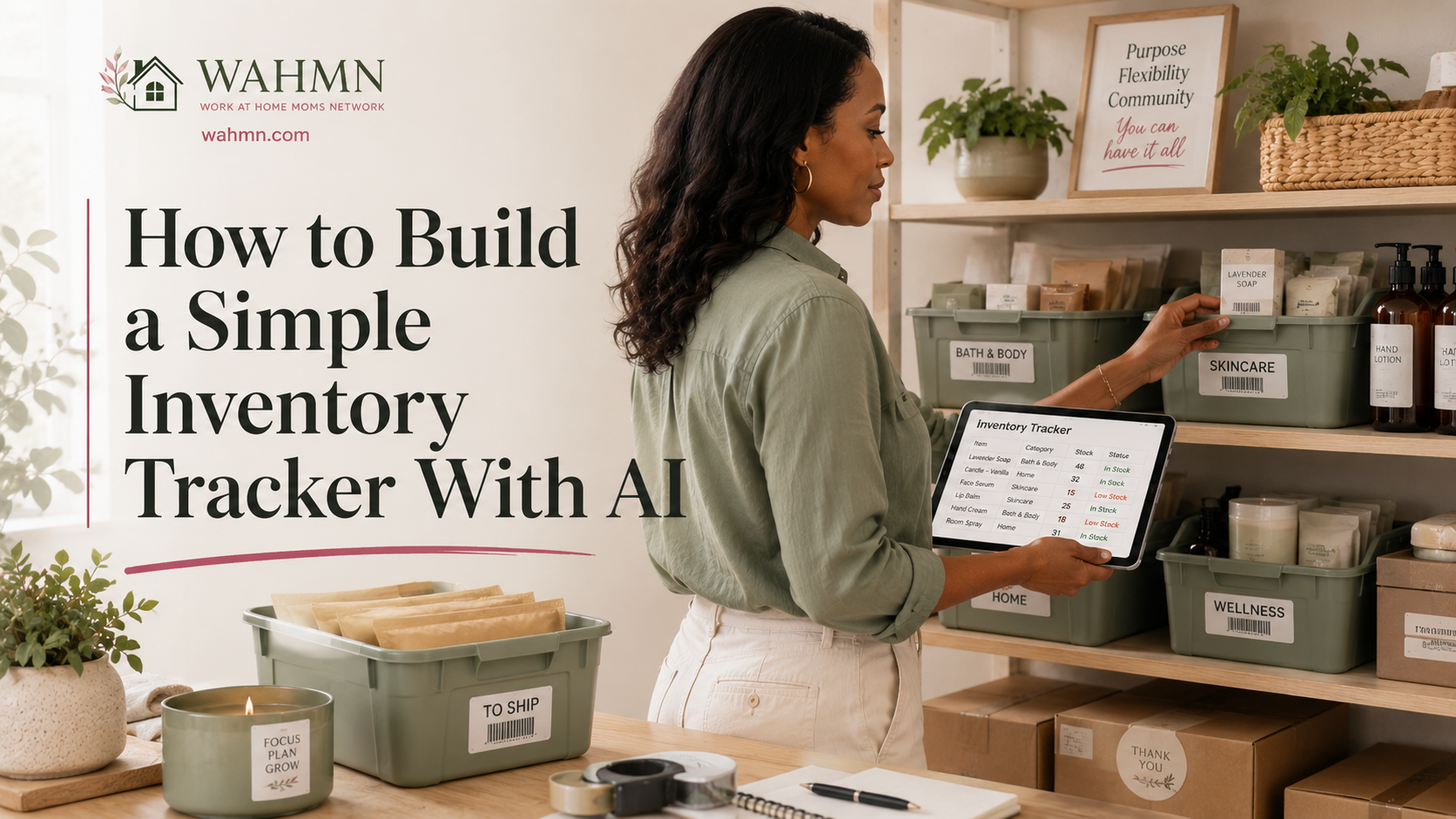
How to Build an Inventory Tracker With AI
In this article
If you sell physical products, supplies have a way of getting away from you.
You think you have six candle jars left, but there are actually two. You order more ribbon because you forgot about the unopened box in the closet. A customer orders an item that your spreadsheet says is available, only to discover that the last one sold three days ago.
You do not necessarily need expensive inventory software to fix this.
For a small product business, you can build an inventory tracker with AI using a tool you may already know: Google Sheets.
And when I say “build,” I do not mean asking ChatGPT to make something mysterious and hoping it works.
In this guide, we’re going to build an actual inventory tracker system together.
By the end, you will have a tracker that can:
- Keep a master list of your products or supplies
- Track the quantity you currently have
- Record inventory coming in and going out
- Calculate your available inventory
- Flag products that are running low
- Store supplier information
- Track unit costs
- Separate inventory by location if needed
- Create a basic low-stock dashboard
- Give you a record of inventory adjustments
- Be expanded later if your business grows
You can create a basic version without coding.
Google confirms that anyone with a Google Account can create and use Google Sheets. Sheets also includes sharing controls, revision history, Excel compatibility, and ways to extend spreadsheets through add-ons and developer tools.
That makes it a good starting point for the type of small inventory system we’re building here.
WAHMN Note: AI should help you build the system. It should not be responsible for deciding whether your inventory numbers are correct. You still need to test formulas and occasionally compare the spreadsheet with what is physically sitting on your shelf.
Table of Contents
- What We Are Building
- Do You Need an Inventory Tracker or Inventory Software?
- What You Need Before You Start
- The Simplest Tool Stack
- Step 1: Decide What You Need to Track
- Step 2: Create Your Inventory Master Sheet
- Step 3: Create a Transaction Log
- Step 4: Have AI Create Your Inventory Formulas
- Step 5: Create Low-Stock Alerts
- Step 6: Add Supplier and Reorder Information
- Step 7: Create a Simple Inventory Dashboard
- Step 8: Test the Tracker Before Using It
- Step 9: Import Your Real Inventory
- Step 10: Create an Inventory Routine
- Copy-and-Paste AI Prompts
- When Airtable Might Be Better
- When AppSheet Might Be Better
- When You Should Buy Inventory Software Instead
- What This Really Costs
- Security, Privacy and Backups
- Common Inventory Tracker Mistakes
- How to Expand the Tracker Later
- Frequently Asked Questions
What We Are Building
For this tutorial, we’re going to assume you run a small product-based business.
You might sell:
- Handmade jewelry
- Candles
- Soap
- Gift baskets
- Clothing
- Craft products
- Sewing products
- Home décor
- Digital products that also require physical supplies
- Personalized gifts
- Party decorations
- Floral arrangements
- Vintage products
- Etsy products
- Products through your own website
- Products locally
Our basic inventory tracker will have three main pieces.
1. Inventory Master
This is where you see what you have.
For example:
| SKU | Item | Category | Quantity | Reorder Point | Unit Cost | Supplier |
|---|---|---|---|---|---|---|
| CND-001 | 8 oz. Amber Jar | Containers | 26 | 12 | $1.18 | Supplier A |
| WCK-001 | Cotton Wick | Supplies | 74 | 30 | $0.09 | Supplier B |
| OIL-004 | Vanilla Oil | Fragrance | 5 | 3 | $8.50 | Supplier C |
2. Transaction Log
Instead of constantly changing the quantity manually, you record what happened.
For example:
| Date | SKU | Type | Quantity | Notes |
|---|---|---|---|---|
| Aug. 20 | CND-001 | Stock In | 24 | Supplier shipment |
| Aug. 21 | CND-001 | Stock Out | 4 | Production |
| Aug. 22 | CND-001 | Adjustment | -1 | Broken jar |
This gives you a history.
If something looks wrong later, you can investigate it.
3. Low-Stock View
This tells you what needs attention.
If an item has 8 units remaining and your reorder level is 10, the system flags it.
That is already enough inventory management for many very small businesses.
Do You Need an Inventory Tracker or Inventory Software?
Before building anything, I want you to answer one question:
Is your inventory problem actually simple?
Building your own tracker makes sense when:
- You have a relatively small number of products or supplies.
- One or only a few people manage inventory.
- You do not operate several warehouses.
- Inventory does not need to synchronize instantly across many sales channels.
- You do not need complicated manufacturing calculations.
- You mainly need to know what you have, what moved and what needs reordered.
- You are comfortable maintaining a spreadsheet.
You may be better off buying inventory software when:
- You operate multiple warehouses.
- Inventory must synchronize with several ecommerce channels.
- You process a large number of orders.
- You need serial-number or batch tracking.
- You need extensive barcode workflows.
- You have several employees updating stock.
- You need purchase orders integrated into a broader accounting system.
- Inventory errors could create serious financial, compliance or fulfillment problems.
This matters because AI makes it tempting to build far more software than you actually need.
Just because AI can help you make a complicated application does not mean you should.
Our rule at WAHMN is:
Build the smallest system that solves the problem.
What You Need Before You Start
You need four things.
A Google Account
For the tutorial, we’re using Google Sheets.
Google says anyone with a Google Account can create Sheets.
You do not need to buy Google Workspace simply to build this spreadsheet.
If you already use Google Workspace for your business, that’s fine too.
As of August 2026, Google’s published annual-plan pricing starts at $7 per user per month for Business Starter, $14 for Business Standard and $22 for Business Plus. Business plans provide additional business email, storage, security and AI features.
Check Google’s current pricing before purchasing because subscription pricing can change.
An AI Assistant
You can use an AI assistant that is good at spreadsheet formulas and step-by-step technical help.
Examples include:
- ChatGPT
- Claude
- Gemini
You do not need a special “inventory AI.”
Your Inventory Information
Gather whatever records you currently have.
That might be:
- Another spreadsheet
- Receipts
- Supplier invoices
- Etsy records
- Shopify records
- Written lists
- A notebook
- Physical product counts
About 5 to 10 Sample Products
Do not begin by loading 2,000 items into an untested spreadsheet.
We are going to build the tracker using sample data first.
Once we know it works, we’ll add the real inventory.
The Simplest Tool Stack
For most beginners, I recommend:
Google Sheets + ChatGPT, Claude or Gemini
That’s it.
You do not need:
- Zapier
- Make
- A database server
- API access
- Custom software
- Hosting
- Barcode equipment
- A developer
Not yet.
Those things become useful only when there is a reason for them.
Step 1: Decide What You Need to Track
Do this before asking AI to make anything.
Open a blank document or simply answer these questions on paper.
What are you tracking?
Decide whether your spreadsheet will track:
- Finished products
- Raw materials
- Supplies
- Packaging
- Equipment
- All of the above
What makes one item different from another?
For example, a T-shirt seller might need:
- Design
- Size
- Color
A candle business might need:
- Container
- Scent
- Size
- Wick
- Finished candle SKU
A jewelry business may need:
- Metal
- Stone
- Size
- Finished product
- Component inventory
What information do you actually need?
A good starting list is:
- SKU
- Item name
- Category
- Variant
- Unit of measure
- Quantity
- Reorder point
- Supplier
- Supplier SKU
- Unit cost
- Storage location
- Status
- Notes
You do not need every field.
For example, if everything lives in one craft room, “storage location” may be unnecessary.
What Is a SKU?
SKU stands for stock keeping unit.
It is simply a unique code you assign to an item.
Instead of relying on names such as:
Blue Floral Large Tote
you might assign:
BAG-FLR-BLU-L
That makes it easier for your spreadsheet to distinguish one product from another.
Do not make your SKU system so elaborate that you need a decoder ring to understand it.
The primary requirement is uniqueness.
Step 2: Create Your Inventory Master Sheet
Open Google Sheets.
Create a blank spreadsheet.
Rename it:
Business Name Inventory Tracker
At the bottom, rename Sheet1:
Inventory Master
Now enter these headings across Row 1:
- A1: SKU
- B1: Item Name
- C1: Category
- D1: Variant
- E1: Unit
- F1: Opening Quantity
- G1: Stock In
- H1: Stock Out
- I1: Adjustments
- J1: Current Quantity
- K1: Reorder Point
- L1: Reorder Status
- M1: Unit Cost
- N1: Inventory Value
- O1: Supplier
- P1: Supplier SKU
- Q1: Location
- R1: Notes
Your sheet now has the basic structure.
Freeze your header row
In Google Sheets:
- Click View.
- Choose Freeze.
- Choose 1 row.
Your headings will stay visible as you scroll.
Turn on filters
- Highlight Row 1.
- Click Data.
- Select Create a filter.
You’ll now be able to sort and filter your inventory.
Suggested Screenshot #1
Screenshot: Blank Inventory Master sheet showing all column headings.
Caption: Start with a master inventory sheet that contains only the information you actually need.
Suggested alt text: Build inventory tracker with AI Google Sheets inventory columns
Step 3: Create a Transaction Log
Click the + at the bottom of Google Sheets to create another worksheet.
Rename it:
Transactions
Create these headings:
- A1: Date
- B1: Transaction ID
- C1: SKU
- D1: Item
- E1: Transaction Type
- F1: Quantity
- G1: Reason
- H1: Reference
- I1: Entered By
- J1: Notes
Your transaction types might include:
- Stock In
- Stock Out
- Adjustment
- Return
- Damaged
- Personal Use
- Sample
- Transfer
Why use a transaction log instead of simply changing inventory quantities?
Because the log tells you why your quantity changed.
Suppose your spreadsheet says you should have 17 products, but you only find 14.
A transaction history gives you somewhere to investigate.
Without one, you simply know your number is wrong.
Step 4: Have AI Create Your Inventory Formulas
This is where AI becomes genuinely useful.
Instead of searching Google for spreadsheet formulas and trying to adapt formulas written for someone else’s sheet, tell the AI exactly how yours is structured.
Use this prompt:
Prompt: Inventory Formula Builder
I am building a small-business inventory tracker in Google Sheets.
My Inventory Master sheet has these columns:
A SKU
B Item Name
C Category
D Variant
E Unit
F Opening Quantity
G Stock In
H Stock Out
I Adjustments
J Current Quantity
K Reorder Point
L Reorder Status
M Unit Cost
N Inventory Value
O Supplier
P Supplier SKU
Q Location
R NotesMy Transactions sheet has:
A Date
B Transaction ID
C SKU
D Item
E Transaction Type
F Quantity
G Reason
H Reference
I Entered By
J NotesI want the Inventory Master to calculate Stock In, Stock Out, Adjustments, Current Quantity, Reorder Status and Inventory Value automatically from the Transactions sheet.
Give me the Google Sheets formula for each calculated column. Explain each formula in plain English. Do not invent column names or change my spreadsheet structure. Tell me where each formula should be entered and how to fill it down. Include sample test transactions so I can verify the calculations manually.
Notice what this prompt does.
We didn’t say:
Build me an inventory system.
We gave AI:
- The software
- The sheet names
- Exact columns
- Desired outcome
- Boundaries
- A request for explanation
- A request for test cases
That dramatically reduces guesswork.
The Inventory Math You Need to Understand
No matter what formula AI gives you, the basic logic should be understandable.
At the simplest level:
Current Quantity = Opening Quantity + Stock In – Stock Out + Adjustments
Example:
You start with:
25 units
You receive:
10 units
You sell:
7 units
You discover:
1 damaged unit
The calculation is:
25 + 10 – 7 – 1 = 27 units remaining
You should be able to calculate several sample products yourself and compare your answer with the spreadsheet.
If the spreadsheet gives you 34, something is wrong.
Do not assume the AI is right because the formula looks complicated.
Step 5: Create Low-Stock Alerts
Now we’ll make the spreadsheet tell you when it is time to reorder.
Your Inventory Master already contains:
- Current Quantity
- Reorder Point
- Reorder Status
Suppose:
Current Quantity = 8
Reorder Point = 10
The status should show something like:
REORDER
If Current Quantity = 22 and Reorder Point = 10, it might say:
OK
Use this prompt:
In my Google Sheets Inventory Master, Current Quantity is column J, Reorder Point is column K and Reorder Status is column L.
Give me a formula for L2 that displays “REORDER” when Current Quantity is less than or equal to the Reorder Point and “OK” otherwise.
Explain exactly how the formula works.
Then add conditional formatting.
To highlight low-stock products:
- Highlight the Reorder Status column.
- Click Format.
- Click Conditional formatting.
- Create a rule for cells containing
REORDER. - Choose a noticeable formatting style.
- Click Done.
Now low-stock items become visually obvious.
Suggested Screenshot #2
Screenshot: Inventory sheet with several rows, including one visually highlighted REORDER status.
Caption: Conditional formatting lets you spot low-stock products without scanning every quantity.
Suggested alt text: AI inventory tracker low stock reorder alert in Google Sheets
Step 6: Add Supplier and Reorder Information
Inventory tracking becomes far more useful when it tells you what to do next.
For every product or supply you regularly reorder, consider storing:
- Supplier
- Supplier item number
- Typical order quantity
- Reorder point
- Typical lead time
- Last purchase price
- Minimum order requirements
- Supplier notes
You can create another tab called:
Suppliers
Possible columns include:
| Supplier | Contact | Website | Phone | Typical Lead Time | Minimum Order | Notes |
|---|
This saves you from searching old emails every time you run low.
How should you choose a reorder point?
Do not let AI make up a number.
Your reorder point depends on things such as:
- How quickly you use the item
- How long your supplier takes to deliver
- Whether sales are seasonal
- Whether the supplier frequently runs out
- How much safety stock you want
For example, if you normally use 10 units a week and your supplier takes two weeks to deliver, setting your reorder point at 3 would obviously be too low.
AI can help you calculate a reorder point.
But you provide the real business assumptions.
Try:
I use approximately 12 units of this product each week. My supplier normally takes 10 days to deliver, but occasionally takes as long as 17 days. Help me calculate a reasonable reorder point and explain the assumptions. Do not assume missing information. Ask me questions first if additional information is required.
That last sentence is important.
Teach AI to ask rather than invent.
Step 7: Create a Simple Inventory Dashboard
You do not need an elaborate dashboard filled with gauges and charts.
Your first dashboard should answer useful questions.
Create a new sheet called:
Dashboard
Useful information might include:
- Number of active inventory items
- Number of items that need reorder
- Total inventory value
- Number of items currently at zero
- Most valuable inventory category
Ask your AI assistant:
Help me create a simple dashboard in Google Sheets using my Inventory Master sheet.
I want the dashboard to show:
- Total number of inventory SKUs
- Number with Reorder Status = REORDER
- Number with Current Quantity = 0
- Total inventory value based on column N
Give me one Google Sheets formula at a time. Explain each formula before moving to the next. Do not add charts or additional metrics yet.
Why one formula at a time?
Because troubleshooting is easier when you know exactly which change broke something.
Suggested Screenshot #3
Screenshot: A clean four-metric dashboard.
Caption: Your first inventory dashboard only needs to answer the questions you actually use to make decisions.
Suggested alt text: simple inventory dashboard built with AI and Google Sheets
Step 8: Test the Tracker Before Using It
This is one of the most important parts of the entire project.
Do not skip it.
Create five fake products.
Example:
| SKU | Product | Opening Qty | Reorder Point |
|---|---|---|---|
| TEST-001 | Sample A | 20 | 5 |
| TEST-002 | Sample B | 10 | 4 |
| TEST-003 | Sample C | 6 | 3 |
| TEST-004 | Sample D | 0 | 5 |
| TEST-005 | Sample E | 50 | 10 |
Now create transactions.
Test 1: Stock In
Sample A starts at 20.
Enter a Stock In transaction for 10.
Expected quantity:
30
Test 2: Stock Out
Enter a Stock Out transaction for 8.
Expected quantity:
22
Test 3: Damage
Record an adjustment of -2.
Expected quantity:
20
Test 4: Low-Stock Alert
Take Sample B below its reorder point.
Verify that its status changes to:
REORDER
Test 5: Zero Inventory
Reduce Sample C to exactly zero.
Verify:
- Quantity displays zero
- No formula error occurs
- Reorder warning appears
Test 6: Duplicate SKU
Enter the same SKU twice in the master inventory.
Your system should not silently treat two different records as the same product.
You can ask AI to help create a duplicate warning.
Test 7: Wrong SKU
Enter a transaction for a SKU that does not exist.
Determine what happens.
Ideally, you want the system to flag it rather than quietly ignoring the transaction.
Test 8: Physical Math Check
Calculate the transactions manually.
Do not rely on the spreadsheet to validate itself.
A Simple Inventory Testing Checklist
Before using the system with real inventory, confirm:
- Stock In increases inventory correctly.
- Stock Out decreases inventory correctly.
- Negative adjustments decrease inventory.
- Returns are handled correctly.
- Zero inventory displays correctly.
- Low-stock warnings trigger at the correct level.
- Incorrect SKUs are identified.
- Duplicate SKUs are identified or prevented.
- Inventory value calculations are correct.
- Filters work.
- Your dashboard matches the Inventory Master.
- You can explain the important formulas.
- You have saved a clean backup.
Step 9: Import Your Real Inventory
Once the test version works, you can begin adding your actual inventory.
Do this carefully.
For physical products, your spreadsheet is only as accurate as the starting count.
That means you may need to perform a physical inventory.
Count what is actually there.
Do not assume the number in an old spreadsheet is correct.
For each item:
- Assign or verify the SKU.
- Enter the item name.
- Enter its category.
- Enter the correct opening quantity.
- Add the reorder point.
- Add the unit cost if you want inventory-value reporting.
- Add the supplier.
- Add the storage location if useful.
- Verify the entry before continuing.
For large inventories, work category by category.
For example:
Monday: containers
Tuesday: packaging
Wednesday: raw materials
Thursday: finished inventory
You do not have to finish everything in one sitting.
Step 10: Create an Inventory Routine
A perfect spreadsheet will become useless if no one updates it.
Decide when inventory transactions are entered.
For example:
Whenever stock arrives
Record a Stock In transaction.
Whenever supplies are consumed
Record Stock Out.
Whenever finished goods sell
Record Stock Out if your ecommerce system is not doing it automatically.
Whenever inventory is damaged
Record an adjustment.
Weekly
Review:
- Reorder list
- Zero-stock items
- Unusual adjustments
Monthly
Perform a small physical reconciliation.
Choose a section of your inventory and compare:
Spreadsheet quantity vs. actual quantity
If they differ, find out why.
Quarterly or at another sensible interval
Perform a broader physical count.
The right frequency depends on how quickly your inventory moves.
Copy-and-Paste AI Prompt Pack
Here are prompts you can use while building or maintaining the tracker.
Prompt 1: Build My Structure
I operate a [TYPE OF BUSINESS]. I need to track [FINISHED PRODUCTS / RAW MATERIALS / SUPPLIES / OTHER].
Help me design a simple inventory tracker in Google Sheets.
Before creating anything, ask me up to 10 questions needed to determine my required columns, inventory workflow and reorder needs.
Keep the system appropriate for a small business. Do not add advanced features unless I have a real need for them.
Prompt 2: Audit My Columns
Here are the columns in my current inventory spreadsheet:
[PASTE COLUMNS]
Review them for a small [TYPE] business. Tell me which columns are essential, which are optional, which may be redundant, and what important information I may be missing.
Do not redesign the spreadsheet until you explain your recommendations.
Prompt 3: Create a Formula
I am using Google Sheets.
Sheet name: [NAME]
Relevant columns:
[PASTE COLUMN LETTERS AND NAMES]
I want the sheet to [DESCRIBE OUTCOME].
Give me the exact Google Sheets formula, where I should place it and a plain-English explanation of how it works.
Then give me three sample test cases with the correct expected results.
Prompt 4: Debug a Formula
This Google Sheets formula is not working:
[FORMULA]
The sheet structure is:
[COLUMNS]
The error message is:
[EXACT ERROR]
Diagnose the cause. Do not rewrite unrelated parts of my sheet. Explain what is wrong and provide the smallest correction possible.
Notice that we say exact error.
Do not tell AI:
It doesn’t work.
Give it the actual error message.
Prompt 5: Create Reorder Logic
Help me calculate a reorder point for this item.
Average weekly use: [NUMBER]
Typical supplier lead time: [NUMBER]
Longest recent supplier lead time: [NUMBER]
Current safety stock: [NUMBER OR NONE]
Ask me for any additional information required. Explain the calculation and assumptions before recommending a reorder point.
Prompt 6: Audit the Entire Tracker
I have built a small-business inventory tracker in Google Sheets.
Here is the structure:
[PASTE STRUCTURE]
Here are the important formulas:
[PASTE FORMULAS]
Act as a quality-control reviewer.
Look for:
- Formula errors
- Duplicate-SKU risks
- Ways stock could be double counted
- Missing transaction types
- Negative-quantity problems
- Weak data validation
- Reorder calculation problems
- Maintenance risks
Do not assume the tracker is correct simply because the formulas run.
When Airtable Might Be Better
Google Sheets is not your only option.
Airtable combines spreadsheet-style information with more database-like structure.
It may be worth considering when:
- You want better forms.
- You want different views of the same inventory.
- You have linked tables.
- You want structured records without building a full app.
- Several people need to work with the system.
Airtable currently offers a Free plan designed for individuals, very small teams and lightweight needs. Its Team plan is currently listed at $20 per user per month when billed annually, while Business is $45 per user per month when billed annually.
That does not automatically make Airtable better.
For a one-person business tracking 60 craft supplies, Google Sheets may be much simpler.
When AppSheet Might Be Better
Another path is turning spreadsheet data into a more app-like interface.
Google’s AppSheet can connect to spreadsheets and other data sources and can be useful when you want employees or helpers interacting with inventory through forms and mobile screens rather than directly editing a spreadsheet.
Google currently allows users to build and test AppSheet apps with up to 10 users at no cost. Published pricing is currently:
- Starter: $5 per user/month
- Core: $10 per user/month
- Enterprise Plus: $20 per user/month
Google also states that Core is included in most paid Google Workspace plans.
An AppSheet version might make sense later if you want:
- Mobile inventory entry
- More controlled forms
- Employee access
- App-style navigation
- Workflow automation
But I would not start there unless the spreadsheet itself is already working.
First solve the inventory problem.
Then improve the interface.
What About Glide?
Glide is another no-code option for turning data into business applications.
It can be useful when you want a polished app rather than a spreadsheet.
However, don’t assume that “no code” means “cheap.”
Glide currently offers an entry-level free option, but its business-oriented plans can become much more expensive. Its current business pricing page lists Business starting at $199 per month when billed yearly, with 30 users included, while its newer GlideOS plan structure also shows individual and team options at different price points.
That is why I would not tell a beginning handmade seller to start by building a Glide inventory app.
Use the inexpensive tool until the business creates a reason to upgrade.
When You Should Buy Inventory Software Instead
There comes a point where building your own system stops saving money.
Suppose you now have:
- 3,000 orders a month
- Multiple locations
- Employees receiving inventory
- Barcode requirements
- Returns
- Purchase orders
- Ecommerce synchronization
- Batch tracking
- Accounting integrations
You are no longer solving a spreadsheet problem.
You are running an inventory operation.
At that point, compare dedicated inventory software.
Zoho Inventory
Zoho Inventory currently offers a Free plan for up to 50 orders per month, one user and one location.
Its published annual-plan pricing currently starts at:
- Standard: $29 per organization/month
- Premium: $79
- Plus: $129
- Enterprise: $249
Higher tiers add greater order limits, users, locations and features such as barcode generation, stock counting, serial-number tracking and batch tracking.
Sortly
Sortly is designed specifically around inventory organization and includes features such as mobile access, inventory photos, low-stock alerts, barcode functions and reporting.
Its current Free plan includes up to 100 unique items and one user license. Paid plans raise item and user limits and add additional inventory features.
This is exactly why I would compare before spending weeks building a complicated custom solution.
If mature software already solves 95 percent of the problem for $20, $30 or $50 a month, the DIY system may not be the bargain it appears to be.
What Does It Really Cost to Build an Inventory Tracker With AI?
The original version of this article greatly overstated what a beginner needs to spend.
A simple tracker can potentially cost $0 in additional software if:
- You already have a Google Account.
- You use Google Sheets.
- You have access to an AI assistant that meets your needs.
Google allows anyone with a Google Account to create Sheets. Airtable currently provides a free plan. AppSheet allows free testing with up to 10 users. Zoho Inventory and Sortly also currently provide free entry plans with limitations.
Your actual cost depends on how far you take the system.
| Level | Possible Tools | Approximate Software Approach |
|---|---|---|
| Basic | Google Sheets + existing AI access | Potentially $0 additional |
| Structured database | Airtable | Free to paid per user |
| Small custom app | AppSheet | Free testing, then paid per user |
| Dedicated inventory | Zoho Inventory | Free limited plan or paid |
| Dedicated visual inventory | Sortly | Free limited plan or paid |
| Complex custom system | Developer/no-code stack/APIs | Highly variable |
Verify pricing directly before purchasing any software. SaaS pricing, plan limits and included features change.
Security and Privacy: Do Not Skip This
An inventory spreadsheet may contain more business information than you realize.
It can reveal:
- Product costs
- Supplier relationships
- Sales volume
- Product demand
- Proprietary SKUs
- Manufacturing information
- Profit-sensitive purchasing information
Do not paste an entire business database into an AI tool simply because you want help with one formula.
Usually the AI needs:
- Your column names
- A few fake example rows
- The formula
- The error message
It does not need your complete supplier database.
Use fake data while building
Instead of:
Supplier: ABC Manufacturing
Wholesale cost: $2.14
Annual purchase volume: 11,000 units
use:
Supplier A
Unit cost: $2.00
Sample quantity: 100
The formula works the same.
Protect access
If other people use the tracker:
- Give access only to people who need it.
- Avoid public sharing links.
- Review permissions periodically.
- Remove access when someone leaves the business.
- Use multifactor authentication where available.
Back Up Your Inventory
Your inventory tracker should never exist in one fragile location with no recovery plan.
Google Sheets includes revision history, which can help you recover earlier versions.
I would still periodically export a separate copy.
For example:
File → Download → Microsoft Excel (.xlsx)
Then store the backup somewhere appropriate for your business.
A simple naming system might be:
Inventory-Backup-2026-08-31.xlsx
If something goes badly wrong later, you know what that file is.
Common Mistakes When You Build an Inventory Tracker With AI
Mistake 1: Asking AI to Build Everything at Once
This:
Build me an advanced inventory management application.
is much harder to verify than:
Help me calculate current inventory from these two sheets.
Build in pieces.
Mistake 2: Trusting Formulas You Do Not Understand
You don’t need to become a spreadsheet expert.
But you should understand what the important formulas are supposed to accomplish.
If current inventory is:
Opening + Stock In – Stock Out + Adjustments
you should know that.
Mistake 3: Manually Overwriting Calculated Quantities
If your system calculates Current Quantity, do not casually type a new number over the calculated cell.
Use an adjustment transaction.
Otherwise your audit history breaks.
Mistake 4: Failing to Record Why Inventory Changed
“Quantity = 17” tells you very little.
A transaction record saying:
-2, damaged during shipping
tells you what happened.
Mistake 5: Using Product Names as Your Only Identifier
Names change.
Spelling varies.
SKUs give products consistent identifiers.
Mistake 6: Creating Too Many Categories
If your category system is:
Candle Supplies → Containers → Glass → Amber → 8 oz → Straight Side → Regular
you may have gone too far.
Categorize only as deeply as you actually use.
Mistake 7: Ignoring Physical Counts
A spreadsheet does not make inventory correct.
People forget transactions.
Products break.
Returns happen.
Items get misplaced.
Count physical inventory periodically.
Mistake 8: Building an ERP System Because AI Can
You started because you wanted to know how many gift boxes you have.
Three days later you’re asking AI to build:
- Purchase-order automation
- Supplier portals
- Warehouse transfers
- Demand forecasting
- Barcode systems
- Accounting synchronization
Stop.
Go back to the original problem.
Mistake 9: Building Something You Cannot Maintain
Ask yourself:
If this breaks six months from now, will I understand it well enough to fix it?
If the answer is no, simplify it.
Mistake 10: Ignoring Dedicated Software
DIY is not automatically better.
Once your inventory operation becomes complicated, compare the cost of your time with established inventory platforms.
How to Expand the Tracker Later
Once you’ve used the simple version for a while, you’ll know what is actually missing.
Possible additions include:
Data Validation
Create dropdowns for:
- Categories
- Transaction types
- Locations
- Statuses
This reduces spelling inconsistencies.
Barcode Scanning
Useful once the number of products or transactions justifies it.
Purchase Orders
Generate reorder lists or purchase-order drafts from low-stock items.
Multiple Locations
Add Location IDs and record movements between them.
Finished Product Recipes
For makers, you could create a bill of materials.
For example:
One candle uses:
- 1 jar
- 1 wick
- 8 oz. wax
- 0.7 oz. fragrance oil
- 1 label
Producing ten candles could then deduct the appropriate components.
That is a more advanced inventory system, so I would add it only after the basic tracker works reliably.
Ecommerce Integration
Eventually, you may want inventory to change automatically when orders come through your online store.
At that point, compare:
- Native integrations
- Automation software
- AppSheet
- Airtable
- Dedicated inventory platforms
before building custom connections.
A Better Way to Use AI
The biggest lesson here is not really about inventory.
It is about how to use AI to build business systems responsibly.
AI is excellent at helping you:
- Structure information
- Write formulas
- Troubleshoot errors
- Create test cases
- Explain formulas
- Suggest validations
- Create documentation
- Improve an existing workflow
But the business owner still decides:
- What should be tracked
- What the correct numbers are
- What the reorder threshold should be
- What information is sensitive
- Whether the system is reliable enough
- When the DIY solution has outlived its usefulness
That is the division of labor I want you to remember.
You define the business. AI helps build the tool.
Your Finished Inventory Tracker Checklist
Before calling the project complete:
- Every inventory item has a unique SKU.
- Opening quantities are based on a verified count.
- Stock In is recorded.
- Stock Out is recorded.
- Adjustments are recorded with reasons.
- Current quantity calculates automatically.
- Low-stock items are clearly flagged.
- Reorder points are based on real business needs.
- Supplier information is stored where useful.
- Inventory value calculations have been checked.
- Five or more test products produced correct results.
- You tested zero and negative quantities.
- You tested an invalid SKU.
- You tested duplicate SKUs.
- You know how to enter a correction.
- You know how to restore or replace a broken formula.
- The spreadsheet is backed up.
- Access permissions are appropriate.
- You have a routine for keeping the system current.
If all of those are true, you have something much more useful than an AI-generated spreadsheet.
You have a small inventory system that you understand.
Frequently Asked Questions
Can I build an inventory tracker with AI if I don’t know how to code?
Yes. For a basic inventory tracker, coding usually isn’t necessary.
Google Sheets can handle product lists, transaction logs, calculations, low-stock alerts and basic dashboards. AI can help write and explain the formulas.
If you later need a mobile application, more advanced forms or complex workflows, you can evaluate no-code tools such as AppSheet or Airtable.
Can ChatGPT build an inventory spreadsheet for me?
It can help design the structure, create formulas, identify errors, generate test cases and improve the workflow.
I would still build the spreadsheet in stages and test every important calculation rather than asking AI to create a large system in one pass.
Is Google Sheets good enough for inventory?
For a small business with straightforward inventory requirements, it can be.
Google Sheets provides collaborative editing, sharing controls, revision history and the ability to extend spreadsheets with additional tools.
Once you need sophisticated fulfillment, warehouses, extensive barcode operations or multiple ecommerce integrations, dedicated inventory software is usually worth evaluating.
Is Airtable better than Google Sheets for inventory?
Not automatically.
Airtable gives you more database-like structure and can make linked records, views and forms easier to manage. But Google Sheets is familiar, flexible and may be entirely sufficient for a small operation.
Start with the simplest system that works.
How much does it cost to build an inventory tracker with AI?
A basic system can potentially cost nothing beyond tools you already use.
Google Sheets can be created with a regular Google Account, while Airtable, AppSheet testing, Zoho Inventory and Sortly currently have free entry points or testing options with various limitations.
Advanced systems may involve monthly subscriptions.
Can I add barcode scanning later?
Yes.
But don’t make barcode scanning your first project unless you actually need it.
First make sure your SKUs, inventory transactions and quantities are accurate.
Then investigate barcode options based on the software you choose.
How often should I physically count inventory?
There is no universal schedule.
A high-volume seller may reconcile frequently, while a very small business with slow-moving inventory may do broader counts less often.
The important point is that the physical quantity and digital quantity must occasionally be compared.
What happens if the spreadsheet quantity doesn’t match my actual stock?
Do not simply overwrite the current quantity.
Investigate the difference.
Look for:
- Missing sales
- Unrecorded inventory use
- Returns
- Damage
- Samples
- Duplicate transactions
- Incorrect SKUs
- Data-entry errors
Then record an adjustment with a reason so you preserve the history.
When should I stop using a DIY inventory tracker?
When maintaining the tracker becomes harder, riskier or more expensive than using purpose-built software.
If you’re managing multiple locations, large order volumes, significant fulfillment complexity, extensive barcode workflows or critical ecommerce integrations, compare professional inventory systems before continuing to add homemade features.
The Bottom Line
You do not need to start with a complicated inventory platform simply because you sell products.
For many small businesses, the best first system is surprisingly simple:
A product list. A transaction log. Reliable formulas. Low-stock alerts. Regular physical checks.
AI can make that much easier to build.
The key is using AI as a technical assistant rather than handing it responsibility for your inventory.
Start with five sample products. Build the smallest version. Test the math yourself. Use it in the real world. Then add features only when your business proves that you need them.
That is how you build an inventory tracker with AI that actually helps you run the business instead of becoming another piece of software you have to manage.
Keep reading on WAHMN
More articles in this category, browse the full article library, or explore our business tools and learning paths.
Once stock is under control, the numbers are the next question. The WAHMN Financial Calculator covers pricing and margin, and Marketplace Business covers selling across more than one storefront.