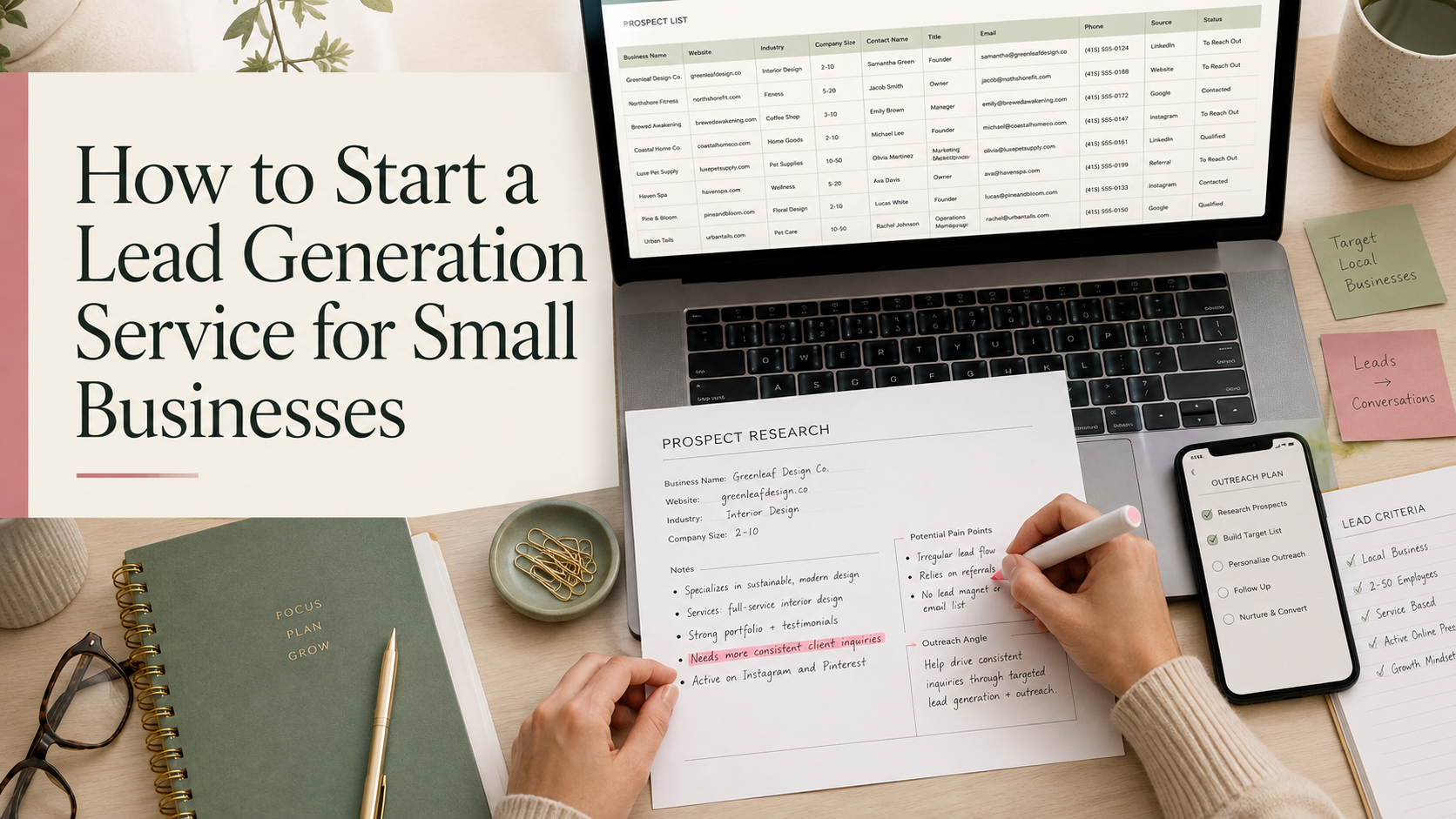
How to Start a Lead Generation Service for Small Businesses
In this article
- Introduction: explain the business model plainly
- What you can sell
- Who this business fits, and who should skip it
- Skills to learn before charging
- Minimum viable tools and startup setup
- Legal, insurance, safety, and professional boundaries
- Create a starter offer
- How to price the work
- How to get the first customers
- Client workflow from inquiry to completion
- Common mistakes and how to prevent them
- A practical 30-day launch plan
Many entrepreneurs in the United States seek reliable ways to help local companies grow. Learning how to start a lead generation service provides a clear path toward building a profitable venture. This business model focuses on helping small firms attract, qualify, and organize potential customers effectively.
This guide offers practical steps rather than abstract marketing theory. We focus on actionable strategies that work in today’s competitive market. You will discover methods for finding your first clients, setting profitable prices, and building a steady pipeline of prospects.
If you are wondering how to start a lead generation service for beginners, you are in the right place. You do not need a massive budget or complex software to succeed. By using a narrow offer, a lean tool stack, and a repeatable process, you can launch your agency with confidence.
Key Takeaways
- Focus on helping small businesses attract and qualify new customers.
- Prioritize practical, real-world tactics over complex marketing theory.
- Build a sustainable income by mastering client acquisition and pricing.
- Keep your initial operations lean with a simple, effective tool stack.
- Use repeatable processes to scale your agency efficiently over time.
Introduction: explain the business model plainly
Learning how to start a lead generation service requires a clear understanding of the value you provide to small business owners. At its core, this business model is about acting as a bridge between a company and its potential customers. You create a trackable path that turns general attention into a specific inquiry.
When you learn how to start a lead generation service step by step, you will find that there are several ways to deliver these results. Most providers choose a specific method that aligns with their strengths and the needs of their clients. Common delivery models include:
- Appointment Setting: You handle the outreach to secure meetings for the business owner.
- Inbound Lead Capture: You build systems like landing pages to collect contact details from interested prospects.
- Outbound Prospecting: You actively reach out to cold lists to identify potential interest.
- Paid Campaign Support: You manage ads on platforms like Google or Facebook to drive traffic.
It is vital to set realistic expectations regarding what you are actually selling. Many beginners confuse a simple contact with a guaranteed sale. You must distinguish between the different stages of the funnel to ensure your clients understand the value of your work.
| Term | Definition | Client Value |
|---|---|---|
| Lead | Basic contact info | Low |
| Qualified Lead | Verified interest | Medium |
| Booked Appointment | Scheduled meeting | High |
| Closed Sale | Final transaction | Highest |
By focusing on these clear definitions, you build trust with your clients. You are not selling a miracle; you are selling a predictable system for growth. When you measure results accurately, you create a sustainable business that provides real ROI for the companies you serve.
What you can sell
Not all lead generation tasks are created equal when you are just starting out. To build a sustainable business, you should focus on services that provide measurable results for your clients. When a business owner can clearly see a form submission or a booked call, they are much more likely to keep paying for your help.
Beginners often find success by focusing on services that bridge the gap between traffic and conversion. For example, building simple landing pages or managing email outreach campaigns allows you to track performance metrics easily. These tasks are highly valued because they directly impact the client’s bottom line.
When you consider how to start a lead generation service pricing, remember that value-based models often outperform hourly rates. You should avoid listing every possible digital marketing task. Instead, pick one primary service, such as appointment booking, and pair it with a supporting service like social media prospecting to create a cohesive package.
The following table compares common services based on their ease of implementation and the clarity of their results for your clients.
| Service Type | Primary Benefit | Ease of Tracking | Recommended Focus |
|---|---|---|---|
| Appointment Booking | Direct Revenue | High | Primary |
| Landing Pages | Lead Capture | High | Primary |
| Email Outreach | Cold Prospecting | Medium | Supporting |
| Social Media | Brand Awareness | Low | Supporting |
As you refine your strategy, keep in mind that how to start a lead generation service pricing depends on the specific value you deliver. By choosing a primary service that generates clear, tangible leads, you make it easier for clients to justify your fees. Focus on quality over quantity to ensure your business remains profitable and scalable.
Who this business fits, and who should skip it
If you are wondering how to start a lead generation service for beginners, you must first assess your own professional strengths. This business model thrives on clear communication, consistent follow-up, and the ability to interpret basic performance data. You do not need to be a technical genius, but you must be comfortable learning new digital tools to track your progress.
This path is an excellent fit for freelancers, sales professionals, and digital marketers who already understand the value of a qualified lead. If you enjoy researching new markets and can handle client conversations with confidence, you are likely well-positioned to succeed. The work requires a structured approach to ensure that every potential customer receives timely attention.
However, this model is not for everyone. If you are seeking immediate passive income, you should skip this venture for now. Lead generation requires active effort, constant outreach, and the resilience to manage rejection from prospects who are not yet ready to buy.
Understanding your personal work style is vital when learning how to start a lead generation service for beginners. The following table highlights the key differences between those who thrive in this space and those who might struggle.
| Trait | Ideal Operator | Potential Struggle |
|---|---|---|
| Communication | Proactive and clear | Avoids phone or email |
| Resilience | Handles rejection well | Takes “no” personally |
| Data Usage | Analyzes results daily | Ignores performance metrics |
| Expectations | Builds for long-term | Wants instant passive pay |
Ultimately, the most successful operators are those who treat their business as a professional service rather than a quick fix. If you are willing to put in the work and refine your process, you can build a sustainable income stream that provides real value to small businesses across the United States.
Skills to learn before charging
If you want to know how to start a lead generation service for beginners, you must first build a solid foundation of skills. Many new entrepreneurs fail because they rush to charge clients before they truly understand the mechanics of lead flow. You should focus on demonstrating process competence rather than just memorizing marketing terminology.
Success in this field relies on a specific set of technical and strategic abilities. You need to become proficient in customer research, offer positioning, and persuasive copywriting. Furthermore, you must master prospect qualification, consistent follow-up, spreadsheet management, and basic conversion tracking to provide real value.
“The secret to building a sustainable business is not in the tools you use, but in the repeatable processes you master before you ever send your first invoice.”
You can practice these skills without risking a client’s budget. Start by running mock campaigns for a fictional company or launching a personal project to test your lead magnets. Volunteering your services for a local non-profit is another excellent way to gain hands-on experience while building a portfolio of results.
The following table outlines how you can bridge the gap between theory and practice. By applying these methods, you will learn how to start a lead generation service for beginners with confidence and professional authority.
| Core Skill | Practical Application | Success Metric |
|---|---|---|
| Customer Research | Analyze local competitor ads | Identify 3 target pain points |
| Copywriting | Draft 5 cold email templates | High open and reply rates |
| Spreadsheet Management | Organize a list of 100 leads | Zero data entry errors |
| Conversion Tracking | Set up a simple landing page | Accurate lead count reporting |
Consistency is your greatest asset during this learning phase. Do not worry about being perfect on your first attempt. Instead, focus on refining your workflow until you can reliably generate high-quality leads for any business you choose to support.
Minimum viable tools and startup setup
Launching your lead generation business requires a lean approach to technology. You do not need expensive enterprise software to begin, as learning how to start a lead generation service step by step is more about your process than your tech stack.
Focus on building a professional foundation first. You need a custom domain and a professional email address to establish credibility with potential clients. When considering how to start a lead generation service tools, prioritize simplicity over complexity to keep your operations agile.
Your essential toolkit should include the following items:
- Professional Domain & Email: Use Google Workspace or Microsoft 365 for a branded presence.
- Portfolio Page: A simple one-page site via Carrd or Squarespace to showcase your offer.
- CRM System: HubSpot or Pipedrive offer free tiers to track your leads.
- Scheduling Tool: Calendly or Cal.com to manage client meetings without back-and-forth emails.
- Tracking & Reporting: Google Sheets or Airtable to manage data and client deliverables.
“Simplicity is the ultimate sophistication in business operations. Start with what you have, validate your model, and scale your tools only when the revenue justifies the expense.”
To ensure a smooth launch, follow this setup order. First, define your specific offer and target audience. Second, create your intake forms and tracking spreadsheets. Third, configure your communication channels, and finally, test your delivery workflow with a mock project.
Understanding how to start a lead generation service startup costs helps you manage your cash flow effectively. While every operator in the United States faces different expenses, the table below provides a realistic range for a lean startup.
| Category | Essential Cost | Optional/Advanced |
|---|---|---|
| Domain & Email | $15 – $20/mo | $50/mo (Premium) |
| Website/Portfolio | $0 – $15/mo | $50+/mo (Custom) |
| CRM & Scheduling | $0 (Free Tiers) | $100+/mo (Pro) |
| Data/Lead Lists | $0 (Manual) | $200+/mo (Paid) |
Keep your initial expenses low by utilizing free versions of software until you secure your first paying client. Consistency in your workflow is far more valuable than having the most expensive software on the market. Once you prove your ability to generate results, you can reinvest your profits into more robust automation tools.
Legal, insurance, safety, and professional boundaries
Building a sustainable agency requires a solid foundation of legal and professional safeguards. When you start, you must prioritize small business lead generation legal considerations to protect your reputation and your assets. A formal, written contract is your best defense against misunderstandings.
Your contract should clearly define the scope of work, payment schedules, and intellectual property ownership. It must also cover data handling procedures, client approval workflows, and specific cancellation terms. Never start a project without a signed agreement that protects both you and your client.
Compliance with United States federal and state laws is non-negotiable. You must stay informed about regulations regarding commercial messaging, such as the CAN-SPAM Act, and rules for recording phone calls. If you handle personal information, you have a legal obligation to ensure that data remains secure and private.
Establishing firm lead generation client boundaries prevents scope creep and protects your professional integrity. You should explicitly state that you do not use purchased lists, engage in spammy tactics, or provide unauthorized access to systems. It is also vital to avoid promising specific sales outcomes, as you cannot control the client’s internal sales process.
Because laws vary by location and industry, you should seek professional advice from a qualified attorney or insurance agent. They can help you navigate business registration, tax obligations, and the right liability insurance for your specific niche. Relying on expert guidance ensures your business remains compliant as you grow.
| Compliance Area | Primary Responsibility | Risk Level |
|---|---|---|
| Data Privacy | Protecting user information | High |
| Commercial Messaging | Adhering to anti-spam laws | High |
| Contractual Scope | Defining deliverables clearly | Medium |
| Professional Liability | Securing business insurance | Medium |
Create a starter offer
Many beginners struggle because they try to sell everything to everyone at once. When you learn how to start a lead generation service, the most effective strategy is to narrow your focus. By creating a specific starter offer, you make it much easier to demonstrate your value to potential clients.
A starter offer acts as a low-risk pilot program. It defines exactly what you will do, who you will help, and what the client can expect in return. This clarity helps you estimate your workload accurately and builds trust with your first few customers.
“Simplicity is the ultimate sophistication.”
To build a successful pilot, you should structure your offer around a clear set of deliverables. A typical starter package might include the following components:
- Target Audience: Define a specific niche, such as local HVAC contractors or boutique law firms.
- Channel: Choose one primary outreach method, like cold email or LinkedIn messaging.
- Deliverables: Include campaign setup, prospect research, and a set number of outreach messages.
- Timeline: Set a firm duration, such as a 30-day trial period.
- Success Metric: Agree on a clear goal, such as the number of booked appointments or qualified leads.
- Client Responsibility: Clearly state what the client must provide, such as access to their CRM or marketing assets.
Using this structured approach is essential when you are figuring out how to start a lead generation service that lasts. By keeping your service bounded, you avoid scope creep and ensure you can deliver high-quality results. This consistency makes it simple to collect your first testimonial, which serves as social proof for future growth.
Ultimately, a well-defined starter offer transforms your business from a vague concept into a professional service. It allows you to refine your processes while providing tangible value to your clients. Once you master this pilot phase, you will have the confidence and the data needed to scale your operations effectively.
How to price the work
Many new entrepreneurs struggle to find the right balance when determining how to start a lead generation service pricing strategy. It is vital to distinguish between your initial business investment and the rates you charge clients. While you might keep your how to start a lead generation service startup costs low by using free tools, your service pricing must reflect the true value and labor involved in delivering high-quality results.
To calculate a sustainable rate, you must account for more than just your time. You need to factor in software subscriptions, taxes, potential revisions, and the inherent risk of the market. A minimum viable price should cover your operating expenses while leaving a healthy margin for profit. Never undervalue your expertise, as low prices often attract clients who demand excessive support.
You should clearly define what constitutes a “qualified lead” before signing any contract. Document your payment timing, replacement policies for bad data, and any specific limits on the volume of leads provided. Establishing these boundaries early prevents disputes and protects your professional reputation.
| Pricing Model | Best For | Key Advantage |
|---|---|---|
| Fixed Project Fee | One-time campaigns | Predictable income |
| Monthly Retainer | Long-term partnerships | Consistent cash flow |
| Per-Qualified-Lead | Performance-based clients | High scalability |
| Hybrid Structure | Complex sales cycles | Balanced risk sharing |
Choosing the right model depends on your client’s specific needs and your comfort with risk. Performance-based models can be lucrative, but they require a proven track record to ensure you are not working for free. Always review your pricing structure quarterly to ensure it aligns with your growing experience and market demand.
How to get the first customers
You do not need a massive marketing budget to land your first few paying customers. Many successful agencies begin by leveraging their existing personal networks and local business connections. When you understand how to start a lead generation service pricing, you can approach these early conversations with confidence and clarity.
Focus your energy on these proven acquisition channels to build momentum:
- Personal Networks: Reach out to friends or former colleagues who own small businesses.
- Local Outreach: Visit local business groups or chambers of commerce to build face-to-face relationships.
- Targeted Email: Send personalized messages that highlight a specific problem you can solve for them.
- Freelance Marketplaces: Use platforms like Upwork to find short-term projects that build your portfolio.
When reaching out to prospects, keep your message short and helpful. Identify a specific pain point, such as a lack of inbound inquiries, and offer a clear improvement. Always end your message with a request for a low-pressure conversation rather than a hard sales pitch.
Transparency is vital when discussing how to start a lead generation service pricing with new clients. Being upfront about your costs helps establish trust and professional boundaries from the very first meeting.
| Service Type | Pricing Strategy | Goal |
|---|---|---|
| Discovery Call | Free | Identify needs |
| Pilot Project | Flat Fee | Prove results |
| Introductory Package | Deposit Required | Secure commitment |
Avoid the trap of relying on a single lucky client to sustain your business. Instead, prioritize building a steady pipeline of prospects through consistent outreach efforts. By balancing your time between active prospecting and delivering high-quality results, you create a sustainable foundation for long-term growth.
Client workflow from inquiry to completion
Managing client expectations requires a clear, step-by-step process from the first inquiry to the final delivery. When you learn how to start a lead generation service step by step, you create a predictable path that builds trust and long-term partnerships.
The journey begins with an initial inquiry where you qualify the prospect. You must determine if their goals align with your expertise and if they have a viable target audience. Once qualified, send a formal proposal and a contract that outlines the scope of work, payment terms, and expected outcomes.
Onboarding is the next critical phase. During this time, you collect essential data, including approved messaging, lead definitions, and consent details. Always secure written client approval before launching any outreach campaign to ensure everyone is aligned on the strategy.
To keep your operations running smoothly, you should leverage specific how to start a lead generation service tools. These platforms help you avoid missed follow-ups and ensure clear ownership of every task.
| Tool Category | Primary Function | Benefit |
|---|---|---|
| CRM | Contact Management | Tracks lead status |
| Shared Tracker | Campaign Progress | Provides transparency |
| Reporting Dashboard | Data Visualization | Shows ROI clearly |
Once the campaign is live, your focus shifts to monitoring and reporting. You should provide regular updates that highlight key performance indicators and outcome notes. If the client requests changes, document these revisions carefully and obtain approval before adjusting your outreach tactics.
Finally, bring the project to a successful completion by reviewing the final results against the initial goals. Maintaining organized records of all interactions and campaign data is essential for professional accountability. This structured approach ensures that your service remains scalable and highly effective for every client you serve.
Common mistakes and how to prevent them
If you want to know how to start a lead generation service mistakes are often your best teachers. Many beginners try to target everyone at once, which dilutes their message and makes it hard to find high-quality prospects. Instead, focus on a narrow niche to build authority quickly.
Another frequent error involves selling unproven outcomes to clients. You should always run a pilot test before promising specific results. This allows you to gather data and set realistic expectations based on actual performance rather than guesswork.
Buying questionable contact lists is a shortcut that usually leads to poor deliverability and damaged reputations. It is much safer to build your own lists through organic outreach and verified sources. Always document your definitions of a “qualified lead” to ensure you and your client are on the same page.
Skipping contracts is a dangerous habit that leaves you vulnerable during disputes. Always use a clear, written agreement that outlines your scope of work and payment terms. This simple step protects your business and establishes professional boundaries from day one.
When learning how to start a lead generation service mistakes often stem from confusing activity with actual business impact. You must distinguish between your controllable service metrics and the client’s final sales results. Use the table below to understand how to manage these expectations effectively.
| Mistake | Prevention Method | Focus Area |
|---|---|---|
| Targeting everyone | Narrow positioning | Strategy |
| Unproven outcomes | Pilot testing | Validation |
| Ignoring quality | Weekly reviews | Optimization |
| Vague expectations | Approval checkpoints | Communication |
Finally, implement weekly quality reviews to catch issues before they become major problems. By checking your lead flow regularly, you can adjust your tactics and ensure you are delivering real value. This proactive approach keeps your clients happy and your business growing steadily.
A practical 30-day launch plan
Building a business from scratch feels overwhelming, but breaking it into 30 days makes it manageable. When you learn how to start a lead generation service, you must focus on one stage at a time to avoid burnout. This structured approach keeps your momentum high while you build your foundation.
To understand how to start a lead generation service step by step, you should divide your month into four distinct phases. The first week is for choosing a niche and crafting a compelling offer. During the second week, focus on practicing your outreach skills and creating basic assets like a simple landing page or a professional LinkedIn profile.
“Success is the sum of small efforts, repeated day in and day out.”
The third week is dedicated to active outreach and running discovery calls. Do not worry about perfection; focus on volume and learning how to handle objections. In the final week, test your workflow to ensure you can deliver results consistently for your first clients.
Managing your budget is a critical part of your journey. You should prioritize essential tools while keeping your how to start a lead generation service startup costs as low as possible until you secure your first paying client.
| Expense Category | Priority | Estimated Cost |
|---|---|---|
| Domain & Email | Essential | $15 – $30 |
| CRM Software | Essential | $0 (Free Tier) |
| Outreach Tools | Wait for Revenue | $50 – $100 |
| Paid Ads | Wait for Revenue | $0 |
At the end of each week, perform a mistake check to stay on track. Review your positioning, ensure your pricing is clear, and verify that your tracking systems are working correctly. Avoiding common how to start a lead generation service mistakes early on will save you significant time and frustration as you scale.
Remember that your goal is to build a sustainable system, not just to chase quick wins. Stay patient, keep refining your process, and always listen to the feedback your prospects provide during your initial conversations.
Growth path
Once you have mastered the basics, it is time to think about how to grow your lead generation service into a sustainable agency. Scaling is not just about adding more clients to your roster. It is about building a repeatable system that maintains high quality as your workload increases.
Before you look for new marketing channels, focus on your current delivery. You must ensure your retention rates are high and your results are consistent. Reliable capacity is the foundation of any successful agency. When you know exactly how long a campaign takes to set up, you can predict your growth more accurately.
Documentation is your best friend during this phase. You should create standard operating procedures for every task, from client onboarding to reporting. When you have clear documentation, you can eventually hire contractors to handle repetitive work. This allows you to focus on higher-value strategy work that drives better results for your clients.
Choosing the right how to start a lead generation service tools is essential for maintaining order. You should look for platforms that offer standardized onboarding, campaign templates, and real-time dashboards. These tools help you track performance and keep your team aligned on client goals.
As you refine your process, consider specializing in a specific vertical. By becoming an expert in one industry, you can charge premium prices and deliver better outcomes. This shift is a natural step for those who know how to start a lead generation service and want to increase their profit margins.
The following table outlines the key stages of your growth journey:
| Growth Stage | Primary Focus | Key Metric |
|---|---|---|
| Solo Freelancer | Manual execution | Client count |
| Systematized Agency | Documented workflows | Retention rate |
| Specialized Firm | Vertical expertise | Profit margin |
| Scaled Operation | Team management | Lifetime value |
Remember that growth should always be based on measurable client value. If your tools and processes do not improve the outcome for your customers, they are not helping you scale. Keep your focus on healthy margins and sustainable delivery to ensure long-term success. Many clients want the posting handled as well, which is where a social media management business comes in.
FAQs to answer
Building a successful agency requires clarity on your business model. Many beginners worry about startup costs, but you can launch with minimal tools like Google Workspace or HubSpot. Focus on tracking outcomes rather than vanity metrics to prove your value to clients.
You might wonder about how to start a lead generation service mistakes that stall growth. The biggest error is overcomplicating your initial offer. Keep your services narrow and measurable to build trust quickly.
Understanding how to start a lead generation service pricing is vital for long-term sustainability. Start with a flat fee for a pilot program before moving to performance-based models. This approach protects your time while you refine your outreach strategies.
Legal boundaries matter when handling prospect data. Always use clear contracts that define what constitutes a qualified lead. This prevents disputes and keeps your professional reputation intact.
Your path to success relies on consistent testing and clear communication. Launch a small, manageable offer today to test your market. You will learn more from your first real client than from any theoretical planning session.
FAQ
What are the typical how to start a lead generation service startup costs for a new entrepreneur?
Is it really possible for someone with no experience to learn how to start a lead generation service for beginners?
Can you explain how to start a lead generation service step by step for a quick launch?
What are the most common how to start a lead generation service mistakes to avoid?
How should I navigate how to start a lead generation service pricing/tools as I grow?
What exactly counts as a “qualified lead” in a professional contract?
How long does it take to see a return on investment in this business?
Do I need to worry about legal regulations like CAN-SPAM or GDPR?
Keep reading on WAHMN
More articles in this category, browse the full article library, or explore our business tools and learning paths.
This is sold rather than stumbled upon. Social Media Marketing Business covers packaging and pricing client services, and Business Launcher covers contracts and the first few clients.