
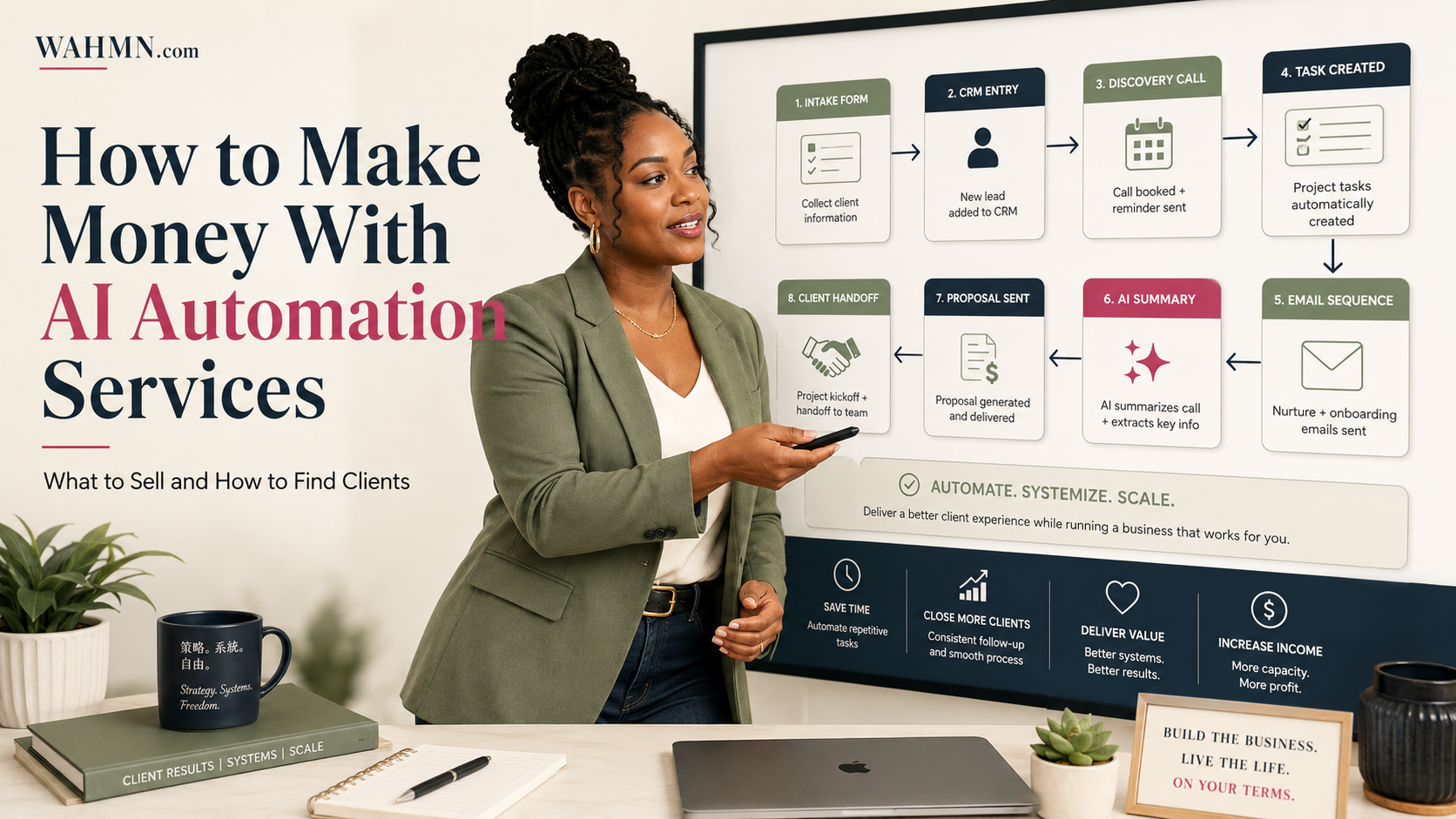
How to Make Money With AI Automation Services: What to Sell and How to Find Clients
In this article
- Introduction
- Automation vs AI automation
- Sell the business outcome, not "AI"
- Beginner-friendly services
- Services beginners should not start with
- Pick one client type
- Find one repetitive problem
- Choose one platform first
- Build three demo automations
- Document business benefit
- Package the service
- Pricing
The digital landscape in the United States is shifting rapidly. Many entrepreneurs are now looking for ways to capitalize on modern technology to build a sustainable income. Starting an AI automation business is one of the most effective paths for those ready to solve real-world problems for companies.
You do not need to be a coding expert to succeed in this field. Instead, you must focus on identifying specific pain points that businesses face daily. By offering measurable value, you can turn simple technical tasks into a high-demand career.
This guide explores how to select profitable offers that resonate with your target market. We will also cover proven strategies to attract your first paying customers. Mastering these AI automation services will help you scale your operations and achieve long-term growth in a competitive market.
Key Takeaways
- Focus on solving specific business problems rather than just selling technology.
- Identify high-value niches where efficiency gains lead to clear financial returns.
- Build a professional portfolio that highlights your past successes and results.
- Use outreach strategies that prioritize building genuine relationships with potential clients.
- Communicate your value proposition clearly to justify your pricing structure.
Introduction
Many companies in the United States are looking for ways to bridge the gap between their manual tasks and smart technology. Business owners often feel overwhelmed by the sheer volume of repetitive work that keeps their teams from focusing on growth. This is where AI automation services become a vital asset for modern operations.
You do not need a massive agency or a complex technical product to enter this space. In fact, a successful AI automation business can begin by solving just one narrow, painful problem for a specific type of client. By focusing on a single workflow, you can deliver immediate value without the overhead of a large team.
American businesses prioritize clear communication, reliability, and measurable results. When you approach a potential client, they care less about the underlying code and more about how your solution saves them time or money. Providing a professional, outcome-focused service is the key to building long-term trust in this industry.
The following table outlines the shift from traditional manual workflows to modern automated processes that clients value most:
| Workflow Type | Manual Approach | Automated Outcome |
|---|---|---|
| Data Entry | Manual Typing | Instant Syncing |
| Customer Support | Email Queues | Smart Routing |
| Lead Management | Spreadsheet Tracking | Automated CRM Updates |
| Reporting | Weekly Manual Prep | Real-time Dashboards |
Starting your AI automation business requires a shift in mindset. Instead of selling “AI,” you are selling the business outcome of a more efficient workday. As you refine your AI automation services, you will find that simplicity often leads to the most sustainable and profitable results.
Automation vs AI automation
Before you launch your career, you need to clarify what separates simple automation from AI-driven solutions. Many beginners often confuse these two concepts, but they serve very different purposes in the modern workplace.
Standard automation relies on rigid, rule-based logic. It follows a strict “if this, then that” path to complete repetitive tasks like moving files or sending emails. It does not learn or adapt; it simply executes pre-programmed instructions with perfect consistency.
In contrast, AI automation involves systems that can interpret, generate, classify, or summarize complex information. An effective AI automation freelancer must understand how to combine these two approaches to build truly powerful workflows. While standard tools handle the heavy lifting of data movement, AI adds the “brain” needed to process unstructured content.
When you offer AI automation services, you must set clear expectations with your clients. You should explain that while standard automation provides reliable efficiency, AI provides the intelligence required to handle nuanced business decisions. Mastering both allows you to solve a wider range of problems and deliver higher value to every project you take on.
Sell the business outcome, not “AI”
Your clients are not looking for artificial intelligence; they are looking for solutions to their biggest headaches. When you pitch AI automation services, most business owners hear “expensive tech project” rather than “business growth.” They do not want to buy a complex system; they want to buy back their time and increase their profit margins.
Successful consultants focus on the transformation their work provides. Instead of explaining how a neural network functions, describe how your AI workflow automation services will eliminate manual data entry errors. Explain how your solution ensures every lead gets a response in under five minutes, regardless of the time of day.
When you shift your language, you stop being a vendor and start being a partner. Use the table below to see how to reframe your sales conversations for better results.
| Tech-Focused Pitch | Outcome-Focused Pitch | The Business Benefit |
|---|---|---|
| “I build AI chatbots.” | “I help you capture leads 24/7.” | Increased revenue |
| “I use LLM integrations.” | “I reduce your admin time by 10 hours.” | Lower labor costs |
| “I automate workflows.” | “I eliminate manual data entry errors.” | Higher data accuracy |
| “I deploy AI agents.” | “I speed up your customer response time.” | Improved satisfaction |
Focusing on these specific operational results makes your value proposition clear and undeniable. When a client understands that your work directly impacts their bottom line, the price of your service becomes a secondary concern. Always lead with the benefit, and let the technology remain the silent engine behind the scenes.
Beginner-friendly services
Starting an AI automation business does not require a degree in computer science or years of coding experience. The most successful newcomers often begin by solving small, repetitive problems that businesses face every single day. By focusing on manageable delivery, you can build a reputation for reliability before attempting complex projects.
When you offer AI automation services, prioritize tasks that have clear, predictable outcomes. Excellent starting points include lead qualification, drafting routine emails, and setting up appointment workflows. These tasks are perfect because they rely on logic that is easy to test and maintain.
“Simplicity is the ultimate sophistication.”
Beginners should stick to familiar platforms like Zapier or Make.com to keep the technical barrier low. You want to design workflows with limited decision points to ensure the system does not break under pressure. Always include a clear human review procedure so your clients feel in control of the final output.
The following table highlights why these specific services are ideal for those just entering the market:
| Service Type | Complexity Level | Client Benefit |
|---|---|---|
| Lead Qualification | Low | Faster sales cycles |
| Email Drafting | Low | Reduced admin time |
| Support Triage | Medium | Improved response speed |
| Document Summary | Medium | Better information flow |
Avoid the temptation to build overly complex systems that look impressive but fail often. A simple, working automation is far more valuable to a business owner than a fragile, high-tech solution. By mastering these foundational tasks, you create a stable base for your growing AI automation business.
Services beginners should not start with
Building a sustainable AI automation business means learning to say no to high-stakes workflows. While the urge to accept every incoming project is strong, some tasks carry risks that can overwhelm a new provider. Taking on work that exceeds your current technical or legal capacity often leads to unnecessary complications.
You should avoid projects involving mission-critical infrastructure or highly regulated industries. In the United States, sectors like healthcare, finance, and legal services operate under strict compliance standards. If you lack deep expertise in these areas, you risk mishandling sensitive data or violating federal regulations.
Consider the following areas that are generally too risky for those just starting their AI automation services:
- Healthcare data processing: Managing patient records requires HIPAA compliance that goes beyond basic automation.
- Financial transaction systems: Automating payments or banking workflows creates massive liability if errors occur.
- Complex custom software development: Building proprietary tools from scratch often leads to scope creep and technical debt.
- High-security authentication: Handling user credentials or sensitive security protocols requires advanced cybersecurity knowledge.
Accepting these projects can result in severe legal, financial, and reputational damage. A single data breach or a failed system integration can destroy your professional credibility before you gain momentum. Protecting your reputation is just as important as generating revenue.
Focusing on simpler, lower-risk workflows allows you to build a solid foundation. By choosing projects that provide clear value without requiring advanced security certifications, you ensure a smoother path to growth. Always prioritize data privacy and operational safety as you scale your business.
Pick one client type
Focusing on a single industry allows you to master the specific problems your clients face. When you try to sell AI automation services to every business owner you meet, your message often gets lost in the noise. By narrowing your focus, you become an expert in a specific field rather than a generalist.
As an AI automation freelancer, your goal is to build a reputation for solving unique pain points. When you stick to one client type, you can create a portfolio of case studies that speak directly to their needs. This makes your outreach much more effective because you are not guessing what they want; you already know their daily struggles.
Consider targeting one of these specific sectors to streamline your prospecting efforts:
- Local service companies: Businesses like plumbing or landscaping that need help with scheduling and lead follow-up.
- Recruitment agencies: Firms that spend hours manually screening resumes and scheduling interviews.
- Ecommerce operators: Online stores that require automated customer support and inventory management.
- Professional firms: Law or accounting offices that need to automate document processing and client intake.
- Real estate teams: Groups that need to nurture leads and manage property listings automatically.
Choosing a niche transforms your outreach from a cold pitch into a valuable business conversation. You will find that your messaging becomes sharper, and your ability to demonstrate ROI increases significantly. Instead of explaining what AI is, you can show exactly how you solve a specific, repetitive problem for that industry.
This strategic approach helps you build stronger examples that resonate with your target audience. When you speak the language of your clients, they trust you faster. Ultimately, specialization is the fastest way to grow your income as an AI automation freelancer providing high-quality AI automation services.
Find one repetitive problem
If you want to sell AI workflow automation services, start by looking for the work people hate doing. Business owners are rarely looking for complex technology; they are looking for relief from tedious, daily chores that steal their time.
You should focus on tasks that happen every single day. When a task is predictable, it becomes the perfect candidate for automation. Look for these common bottlenecks in small businesses:
- Copying information between different software tools.
- Responding to the same customer questions over and over.
- Sorting through incoming email inquiries or support tickets.
- Updating spreadsheets or CRM records manually.
- Preparing routine daily or weekly summaries for management.
To validate if a problem is worth your time, ask the client how much time their team spends on it. If an employee spends two hours a day on a task, that is ten hours a week of lost productivity. Solving this specific pain point provides immediate, measurable value to the business owner.
High-quality AI automation services are built on the foundation of saving money or time. When you identify a task that happens frequently, you can easily calculate the return on investment for your client. This makes your pitch much stronger because you are selling a solution to a real, expensive problem rather than just a piece of software.
Focusing on one clear problem allows you to build a repeatable process. Once you master the automation for one client, you can offer that same solution to others in the same industry. This strategy helps you scale your business quickly while keeping your delivery process simple and effective.
Choose one platform first
Choosing a single, reliable platform is the most important step for your new venture. Many beginners make the mistake of trying to master every tool available at once. This approach often leads to confusion and slow project delivery. Instead, you should focus on learning one robust system deeply to build your AI automation business effectively.
When you specialize in one platform, you gain the ability to create faster demonstrations for your prospects. You will understand exactly how to handle complex workflows without needing to search for documentation constantly. This expertise allows you to provide high-quality AI automation services that clients can trust. Notion work is the easiest specialty to start with, and offering Notion setup services covers the packages and pricing.
“Simplicity is the ultimate sophistication.”
When selecting your primary tool, look for specific features that ensure long-term success. You need a platform that offers strong integrations, clear logging, and reliable support. It is also vital to check if the tool allows for human approvals, which is a critical requirement for many enterprise clients.
| Platform | Best For | Key Strength | Pricing Model |
|---|---|---|---|
| Make | Visual Workflows | Complex Logic | Usage-based |
| Zapier | Quick Setup | Integrations | Tiered Subscription |
| n8n | Self-hosting | Data Privacy | Free/Enterprise |
Reliability is the foundation of your reputation. By sticking to one platform, you learn how to troubleshoot errors quickly and maintain consistent performance for your clients. This focused strategy will help you scale your operations much faster than a broad, shallow approach ever could.
Build three demo automations
Creating three targeted demo automations serves as a powerful bridge between your skills and your first paid contract. You do not need a long list of past projects to launch your AI automation business successfully. Instead, you can build specific examples that prove you understand the unique pain points of your chosen niche.
Each demo should focus on one recurring business problem. By solving a specific issue, you demonstrate that your AI automation services provide real, tangible value rather than just technical complexity. These demos act as your portfolio, showing potential clients exactly how you can save them time and money.
Every demo you build must include these essential components to show professional quality:
- Starting Trigger: The specific event that kicks off the workflow.
- AI Step: The logic or processing layer that handles the data.
- Connected Application: The software where the data is sent or retrieved.
- Human-Review Point: A step where a person verifies the output before final action.
- Final Output: The completed task or generated report.
- Failure Handling: A simple process to notify you if the automation stops.
Consistency is key when building these examples. Ensure each demo reflects a real-world scenario that your target client faces every single day. When you present these to a prospect, you are not just selling code; you are selling a proven solution to their most frustrating bottlenecks.
By focusing on these small, functional builds, you establish trust early in the conversation. This approach allows you to scale your AI automation business with confidence. Even without extensive experience, your ability to show a working system makes you a top choice for companies seeking reliable AI automation services.
Document business benefit
Every successful AI automation freelancer knows that data is their strongest sales tool. When you present a solution, you must move beyond the technical “how” and focus on the tangible “why.” Business owners care about results that impact their bottom line, not just the software you used to build the system.
To build credibility, you need to document the specific improvements your work provides. Start by recording the original manual process in detail. Note the time spent, the frequency of the task, and the current error rate. This baseline allows you to show a clear before-and-after comparison once your system is live.
When you offer AI automation services, your documentation should include these key metrics:
- Time saved: Calculate the hours reclaimed per week.
- Response speed: Measure how much faster the client can reply to leads.
- Error reduction: Track the decrease in manual data entry mistakes.
- Increased capacity: Estimate how many more tasks the team can handle now.
Always be honest about your assumptions and limitations. If your automation relies on a specific third-party API, mention that as a dependency. Never invent results or promise performance levels that you cannot verify with real data. Transparency builds trust, which is essential for long-term client relationships.
By keeping a clean record of these benefits, you turn a simple technical demonstration into a compelling business case. This approach helps you justify your pricing and positions you as a strategic partner rather than just a coder. Use these documents during your sales conversations to show exactly how your work drives growth.
Package the service
You can transform your expertise into a predictable product by creating clear service packages. When you offer AI automation services, you must define exactly what the client receives to avoid scope creep. A structured approach ensures that your business remains profitable and easy to manage.
Clear packaging helps prospects understand the value of your AI workflow automation services before they sign a contract. By setting specific boundaries, you protect your time and ensure that every project stays within its intended timeline. This level of clarity builds trust and makes your sales process much smoother.
Consider organizing your offerings into these four distinct categories to provide a professional experience:
| Service Type | Primary Goal | Deliverable |
|---|---|---|
| Paid Audit | Identify bottlenecks | Strategy report |
| Implementation | Build the system | Live automation |
| Training | Empower the team | Video tutorials |
| Support | Maintain uptime | Monthly updates |
Each package should clearly outline the client access requirements, such as API keys or software credentials. You must also define the specific scope of work and the expected timeline for completion. This prevents confusion and ensures that both parties are aligned on the final results.
Consistency is the key to scaling your agency. When you use standardized packages, you can replicate your success across multiple clients without reinventing the wheel. This repeatable model is the foundation of a truly successful business in the automation space.
Pricing
Setting the right price for your AI automation services is the most critical step in building a profitable business. Many beginners make the mistake of charging only for the time spent building a workflow. Instead, you must account for the entire lifecycle of the project to ensure your venture remains viable.
When you launch your AI automation business, consider these common pricing models to find the best fit for your workflow:
- Project-based: A flat fee for a specific outcome, which is great for building trust with new clients.
- Fixed-scope: Clearly defined deliverables that prevent “scope creep” and protect your profit margins.
- Hourly: Useful for consulting or troubleshooting, though it can limit your earning potential as you become more efficient.
- Recurring: A monthly retainer for maintenance, updates, and ongoing support, providing predictable cash flow.
You should always look beyond the initial build time when calculating your rates. Your pricing must cover the hidden costs of discovery, setup, testing, and client revisions. Documentation and platform subscription fees also add up quickly, so factor these into your final quote.
It is also vital to include a buffer for risk management. If an API changes or a platform update breaks your automation, you need the resources to fix it without losing money. Balancing accessibility for your first few clients with sustainable business economics is the key to scaling your AI automation services effectively.
Ultimately, your goal is to provide high value that justifies your rates. As your AI automation business grows, you can transition from low-cost entry projects to premium, value-based pricing models that reflect the time and money you save your clients.
Calculate value
Calculating the true value of your work is the secret to scaling an AI automation business. When you approach a potential client, you must translate technical efficiency into clear financial gains. Use a simple framework that compares current manual processes against your proposed automated solution.
Start by identifying the frequency of a specific task and the total time employees spend on it. Factor in the hourly labor cost, the frequency of human errors, and the impact of response delays on customer satisfaction. Always present these figures as assumptions or ranges rather than absolute facts, unless the client provides verified operational data.
Because the United States market features diverse labor costs and profit margins, avoid using generic online calculators. Instead, customize your value proposition to reflect the specific economic reality of your client. This tailored approach builds trust and demonstrates that you understand their unique business model.
The following table illustrates how to quantify the impact of your AI automation services by comparing manual workflows to automated ones:
| Metric | Manual Process | Automated Process | Annual Savings |
|---|---|---|---|
| Time per Task | 30 Minutes | 2 Minutes | 280 Hours |
| Error Rate | 5% | 0.1% | $12,000 |
| Response Time | 4 Hours | Instant | High Retention |
| Labor Cost | $25/hr | $2/hr (API) | $6,500 |
By focusing on these metrics, you shift the conversation from a cost-based expense to a strategic investment. This clarity helps business owners see the immediate return on their capital. When you provide this level of transparency, you position yourself as a partner rather than just another vendor.
Find first client
Finding your first client is less about cold calling and more about solving a specific, painful problem. You should start by identifying businesses that struggle with repetitive manual tasks, such as data entry or lead qualification. When you reach out, focus on the business outcome rather than the technical tools you use.
Once you have a lead, qualify them by ensuring they have a budget and a genuine need for efficiency. A professional proposal should clearly outline the scope, the expected time savings, and the total cost. By positioning yourself as a consultant, you build trust and increase your chances of closing the deal.
Build safely
As an AI automation freelancer, your reputation depends on the security of your work. Always request limited access permissions to client systems rather than full administrative rights. You must ensure that sensitive data remains encrypted and that you never store private information on your local machine.
Implement a human-in-the-loop system for all critical decisions. This ensures that the client can review AI outputs before they are sent to customers or saved to a database. Always maintain a backup of your workflows so you can recover quickly if a platform update causes a failure.
Deliver
Delivery is the phase where you prove the value of your AI automation services. Provide the client with clear documentation that explains how the automation works and how to troubleshoot basic issues. You should also define specific acceptance criteria so the client knows exactly when the project is considered complete.
Monthly maintenance
Automation is rarely a “set it and forget it” solution. You should offer a monthly maintenance package to monitor workflows for errors and platform changes. This recurring revenue stream helps you stay profitable while ensuring the client’s systems remain stable over time.
Hidden costs
Many freelancers fail to account for the time spent on client questions and minor adjustments. You must factor these hidden costs into your pricing model to protect your profit margins. The following table outlines common expenses that often catch new freelancers off guard.
| Cost Category | Description | Impact on Margin |
|---|---|---|
| Platform API Fees | Usage costs for AI models | High |
| Troubleshooting | Fixing broken connections | Medium |
| Client Support | Answering email questions | Low |
| Software Updates | Adapting to platform changes | Medium |
Discovery call
Your success depends on how you guide prospects through the initial meeting. A structured discovery call helps you uncover specific pain points, budget constraints, and key decision-makers. Focus on listening to their current struggles to position your AI automation services as the primary solution for their growth.
Executing Your 30-Day Roadmap
Start your engagement with a clear timeline to build trust. Dedicate the first week to deep discovery and process mapping. Spend the second week designing the architecture, followed by a week of rigorous testing. Launch the system in the final week to ensure your AI workflow automation services deliver immediate value.
Common Questions Answered
Clients often worry about data security and long-term ownership. Reassure them that you use industry-standard tools like Make or Zapier with strict privacy protocols. Explain that your pricing reflects the time saved and the revenue generated by these systems. Provide ongoing support packages to maintain the health of their new digital infrastructure.
Take the first step today by reaching out to a business owner who needs help. Your ability to solve real problems will define your reputation in this growing market. Start building your portfolio now to secure your place in the future of work.
FAQ
What is the primary difference between traditional automation and AI workflow automation services?
How do I effectively sell AI automation services to local business owners?
Which platforms should I learn first to start a successful AI automation business?
What are the best beginner-friendly services an AI automation freelancer can offer?
How should I price my offerings when I first start to sell AI automation services?
What industries or tasks should I avoid when providing AI automation services?
How can I prove the value of my AI workflow automation services to a new prospect?
Keep reading on WAHMN
More articles in this category, browse the full article library, or explore our business tools and learning paths.
Automation work is sold on outcomes, not on software. Business Launcher covers packaging, pricing and winning the first clients, and the Hourly Rate Calculator keeps your quotes honest.